AutoFlight unveils integrated sea–air mobility solution
Questions and Answers:
What did AutoFlight unveil in Suzhou? AutoFlight introduced an integrated sea–air mobility system that combines a water-based vertiport with electric vertical take-off and landing aircraft.
What is the purpose of the Zero-Carbon eVTOL Water Vertiport? The vertiport is designed to function as a floating landing site and operations center that supports take-off, landing, charging, and coordination with eVTOL aircraft.
Which aircraft models are compatible with the new system? The system supports AutoFlight's White Shark industrial aircraft, the two-ton-class CarryAll cargo aircraft, and the six-seat Prosperity passenger aircraft.
SUZHOU, China - AutoFlight Aviation Technology in Shanghai has introduced what it describes as the world's first integrated sea–air solution for low-altitude mobility. The system combines a water vertiport with electric vertical take-off and landing aircraft (eVTOL) to support infrastructure development across rivers, lakes, and coastal regions. The company said the concept is intended to advance low-altitude aviation from early testing to operational use and is positioned to support several mission profiles, including energy platform maintenance, emergency response, high-frequency commuting, sea–air tourism, and networks of mobile water-based vertiports.
Related: Joby Aviation begins power-on testing of first FAA-conforming eVTOL aircraft
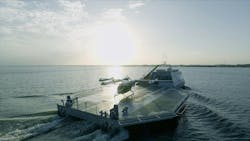
AutoFlight's Zero-Carbon eVTOL Water Vertiport serves as a floating landing site and operations center. It includes landing platforms, photovoltaic charging and energy storage, dispatch systems, and communication equipment. The company said the design allows deployment without land-based construction and can provide take-off, landing, and charging functions while coordinating operations with eVTOL aircraft.
The water vertiport is compatible with several AutoFlight aircraft models, including the industrial-grade White Shark, the two-ton-class cargo aircraft CarryAll, and the six-seat passenger aircraft Prosperity. Together, the aircraft and the water vertiport form what the company describes as an integrated land-sea-air mobility network.
Sea and air in sync
The Sea-Air solution is intended to support a range of applications:
• Marine energy platform maintenance: The system is designed to improve the speed and reliability of transporting personnel and parts to offshore energy platforms by providing an additional aviation option for maintenance operations.
• Emergency response: The combination of aerial search capability and eVTOL deployment is intended to reduce response times and expand coverage for emergency missions near waterways.
• High-frequency commuting: AutoFlight says the system could provide faster mobility between urban, coastal and island locations, potentially reducing travel times compared with surface transportation.
• Sea-air tourism: The company notes that the concept introduces a "flight+" option intended to support tourism operators seeking to add aerial transportation to water-based destinations.
• Mobile vertiport networks: Multiple water vertiports can be linked into a network intended to support multi-aircraft operations with higher throughput.
Low-carbon integrated mobility
AutoFlight states that the water-based vertiport allows aviation infrastructure to be deployed on existing waterways with relatively low land-use impact. The system was developed with battery supplier CATL and incorporates electric power systems for both the aircraft and vertiports. The company said the goal is to support lower-emission aviation operations as interest grows in electric mobility.
About the Author
Jamie Whitney
Editor-in-Chief
Jamie Whitney joined the staff of Military & Aerospace Electronics in 2018 and oversees editorial content and produces news and features for Military & Aerospace Electronics, attends industry events, produces Webcasts, and oversees print production of Military & Aerospace Electronics.
Related
Voice Your Opinion!
To join the conversation, and become an exclusive member of Military Aerospace, create an account today!
 Leaders Logo
Leaders relevant to this article: