ThinKom unveils space-optimized ThinAir Nexus aircraft antenna
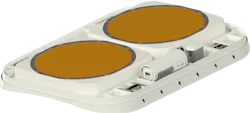
HAWTHORNE, Calif. - ThinKom Solutions Inc. in Hawthorne, Calif., has introduced the ThinAir Nexus, a compact multi-orbit aircraft antenna designed to support geostationary orbit (GEO), medium Earth orbit (MEO), and low Earth orbit (LEO) satellite constellations in a single installation.
The company said Nexus is engineered to match the installation footprint of single-orbit electronically steered antenna (ESA) systems while extending capability to multi-orbit, multi-constellation in-flight connectivity. The design targets airline operators seeking simplified hardware integration without limiting satellite network flexibility.
According to ThinKom, the system provides gigabit-class performance across GEO, MEO, and LEO networks and is designed to support future constellation expansion through modem upgrades rather than antenna replacement.
Nexus is built around ThinKom’s patented variable inclination continuous transverse stub (VICTS) technology, which the company said enables an open network architecture supporting multiple orbital regimes and satellite operators. The architecture is intended to enable service providers to maintain service-level agreements across dense traffic hubs and regions where single-constellation coverage may be limited.
The company said its VICTS-based systems are already fielded across geostationary and non-geostationary satellite orbit networks, including SES Open Orbits, Hughes JUPITER In-Flight, Telesat Lightspeed, and several sovereign satellite systems. Nexus is designed to be orbit-agnostic to support future network deployments.
Aircraft operators can select between multiple modem configurations. An externally integrated modem option incorporates ThinKom’s KANDU and KRFU units mounted outside the fuselage, while an internal multi-modem MODMAN configuration supports increased redundancy and constellation flexibility.
ThinKom said Nexus uses a simplified four-lug fuselage attachment design and is being developed in coordination with Airbus and Boeing to support both line-fit and retrofit installations. The compact form factor is also intended to address requirements in the regional jet segment.
The company said its VICTS technology has accumulated more than 65 million hours of operational use, contributing to a reliability profile designed for continuous gate-to-gate operation. ThinKom also emphasized low power consumption and thermal efficiency, stating the system avoids thermal constraints more commonly associated with ESA-based antenna architectures.
For more information, please visit https://www.thinkom.com/.
