CAE to provide simulation and training for Taiwan F-16 Block 70 jets to replicate avionics and sensors
Key Highlights
Questions and answers:
- Who is providing the F-16 Block 70 training simulators, and for whom are they intended? CAE USA Inc. is providing the simulators for the Republic of China Air Force (ROCAF) in Taiwan under a U.S. Air Force contract.
- What capabilities do the F-16 Block 70 simulators provide? They offer high-fidelity simulation of the F-16 Block 70 cockpit, avionics, sensors, weapons, flight dynamics, and mission environments for pilot and crew training.
- What is the value and schedule of the CAE contract? The contract is valued at $69.9 million, with work performed in Arlington, Texas, and completion expected by August 2028.
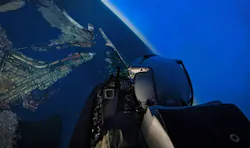
WRIGHT-PATTERSON AFB, Ohio – U.S. Air Force aerial combat experts needed advanced flight simulators for training and mission rehearsal for pilots flying the F-16 Block 70 Viper jet fighter. They found a solution from CAE USA Inc. in Arlington, Texas.
Officials of the Air Force Life Cycle Management Center at Wright-Patterson Air Force Base, Ohio, announced a $69.9 million order to CAE in late January to provide F-16 Block 70 training simulators for the Republic of China Air Force (ROCAF) in Taiwan.
F-16 Block 70 training simulators replicate the experience, procedures, systems, and mission environments of the F-16 Block 70/72 Viper jet fighter for pilot and crew training on the ground. They enable F-16 Viper pilots train in safe and repeatable scenarios before and alongside live flight hours.
The F-16 Block 70 is the latest new-production version of the Lockheed Martin F-16 jet fighter for export. It has modern avionics, sensors, and mission computers comparable to many fifth-generation combat aircraft, while retaining the F-16 airframe.
Avionics and sensors
These simulators provide high-fidelity simulation of the F-16 Block 70 cockpit, avionics and sensors, and weapons, and enable pilots to practice normal flight procedures, combat tactics, emergency responses, instrument flying, and mission profiles without using actual aircraft.
The CAE F-16 Block 70 simulation and training systems consist of full-mission trainers; weapons tactics trainers; and instructor operation stations.
The full-mission trainer is a full-size cockpit replica with the same controls, displays, and interface as the Block 70 aircraft. It offers immersive visual displays like a dome or other kind of high-resolution system to provide wide fields of view for realistic external environments.
Full-mission trainers also offer high-fidelity flight dynamics and tactical environment simulations, including realistic sensors, electronic warfare (EW), and weapon system behavior.
Weapons firing
The simulator's weapons tactics trainer offers a cockpit station that focuses on weapons firing and tactics training. This usually is lower cost than full domed systems, and is for discrete training or supplementary training.
The simulator's instructor operating station enables instructors to set up scenarios, inject threats or failures, monitor performance, and debrief trainees.
These simulators replicate F-16 Block 70 avionics, flight controls, radar, weapons, countermeasures, and sensor models that mirror actual aircraft behavior. Networked simulators enable squadron tactics, coordinated missions, adversary simulation, and joint training.
They offer adjustable weather, lighting, terrain, and threat environments, as well as support night and helmet-cueing systems that are compatible with night-vision devices and helmet-mounted cueing gear. On this order, CAE will do the work in Arlington, Texas, and should be finished by August 2028. For more information contact CAE USA online at www.cae.com/defense-security.