Lockheed Martin to provide flight simulation and computers for C-130J pilots and maintainers
Key Highlights
Questions and answers:
- What is the purpose of the JMATS IV contract awarded to Lockheed Martin? To design, produce, modernize, and sustain the fourth-generation C-130J Maintenance and Aircrew Training System (JMATS IV) to train pilots, loadmasters, aircrew, and maintenance technicians for the C-130J Super Hercules.
- What kinds of training equipment are included in JMATS IV? Full-motion flight simulators, part-task trainers for avionics procedures, loadmaster and cargo-handling trainers, maintenance training systems, and classroom-based simulation software environments.
- What major electronic subsystems make up the JMATS IV training systems? Key subsystems include real-time simulation computing systems, image generation and visual display systems, avionics emulation electronics, glass cockpit display electronics, motion platform control systems, communications and data links, instructor operator stations, and mission debrief and recording systems.
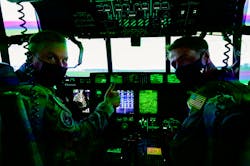
WRIGHT-PATTERS AFB, Ohio – Flight simulation experts at Lockheed Martin Corp. will design, upgrade, and build systems to train crews and maintainers of the Lockheed Martin C-130J Super Hercules transport aircraft under terms of a $1.9 billion 13-year contract announced this week.
Officials of the Simulators Division of the Air Force Lifecycle Management Center at Wright-Patterson Air Force Base, Ohio, are asking the Lockheed Martin Rotary and Mission Systems segment in Orlando, Fla., to provide the C-130J Maintenance and Training System (JMATS) IV system.
This contract is for JMATS IV production, modernization, sustainment, and support. JMATS IV is the fourth-generation C-130J simulation and training system to train crews and maintainers of the Lockheed Martin C-130J Super Hercules transport aircraft.
JMATS IV provides training simulators for C-130J pilots, loadmasters, and other aircrew, including maintenance training devices for ground technicians. The contract includes software, updates, and modernization of training systems. JMATS IV is for the U.S. Air Force, Marine Corps, and Coast Guard.
Full-motion simulators
JMATS IV equipment includes full-motion flight simulators that replicate the C-130J cockpit; part-task trainers for procedures and avionics; loadmaster and cargo-handling trainers; maintenance training systems for engines, avionics, and airframe; and classroom and simulation software environments.
These systems enable C-130J flight and maintenance crews to practice emergency procedures, weather events, and tactical missions without risking aircraft or personnel.
Major electronic subsystems of JMATS IV real-time simulation computing system; image generation and visual display systems; cockpit avionics emulation system; glass cockpit display electronics; flight control and control-loading electronics; motion platform control system; sensor and mission system simulation; communications and data link systems; instructor operator station; mission debrief and data recording systems; maintenance training diagnostics systems; and distributed mission operations networking.
The real-time simulation computing system runs the aircraft simulation, and offers real-time simulation servers; flight dynamics processors; aircraft systems modeling computers; a networked simulation cluster; and data recording and playback systems.
Image generation
The image generation and visual display systems provide the outside-the-window scene seen by pilots. It has image generation computers; terrain databases; graphics rendering; multi-channel video distribution; multi-projector dome displays; and high-resolution projectors. It can provide weather effects; terrain and airfields worldwide; traffic and other aircraft; and weapons and threat visualization.
The cockpit avionics emulation system replicates the entire digital avionics architecture of the aircraft, including flight management system; navigation systems; radar altimeter; autopilot; flight control computers; radio communications; identification friend-or-foe; traffic collision avoidance system; and automatic direction finder.
The glass cockpit display electronics consists of multi-function display processors; head-up display electronics; display interface units; cockpit display graphics generators; and touchscreen or side-by-side glass displays. These displays reproduce navigation maps; engine instruments; flight instruments; tactical mission displays.
The flight control and control-loading electronics offers electro-mechanical control loaders; digital servo controllers; force-feedback actuators; control position sensors; These systems simulate the resistance and behavior of:; yoke; rudder pedals; throttles; and trim systems.
Motion control
The motion platform control system has six-degree-of-freedom motion base; electro-mechanical actuators; motion control computers; inertial measurement sensors; and feedback control loops to convert simulated flight dynamics into physical motion cues.
The sensor and mission system simulation offers weather radar; infrared sensors; navigation sensors; electronic warfare (EW) threat displays; and terrain awareness systems. Some trainers also include simulated cargo compartment and loadmaster systems.
Communications and data link systems replicate military communications such as UHF/VHF radio simulation; intercom systems; datalink emulation; voice communications servers; and tactical message systems to enable crew members in different trainers to communicate during exercises.
The instructor operator station controls the simulation, and include scenario control computers; mission event injection systems; system-failure injection interface; real-time monitoring displays; and training control networks to enable instructors to simulate failures; insert threats; change weather; and track trainee performance.
Mission debriefing
Mission debrief and data recording systems include mission recording servers; playback workstations; synchronized cockpit video; and telemetry-capture systems that enable instructors to review crew actions after a training mission.
Maintenance training diagnostics systems have data transfer and diagnostics systems; ground-based maintenance software; aircraft fault simulation modules; and avionics test interfaces to enable technicians to practice troubleshooting avionics and aircraft electronics.
Distributed mission operations networking links JMATS simulators with other simulators and command centers. It includes distributed simulation gateways; high-speed Ethernet networks; simulation protocols; and secure training networks to enable multi-aircraft training missions across different bases.
On this contract, Lockheed Martin will do the work at Little Rock Air Force Base, Ark.; Dyess Air Force Base, Texas; Cherry Point Marine Corps Air Station, N.C.; Kaneohe Bay Marine Corps Air Station, Hawaii; Elizabeth City Coast Guard Air Station, N.C.; Quonset Point Air National Guard Base, R.I.; Keesler Air Force Base, Miss.; Miramar Marine Corps Air Station, Calif.; Fort Worth Naval Air Station Joint Reserve Base, Texas; Ramstein Air Base, Germany; Yokota Air Base, Japan; and Iwakuni Marine Corps Air Station, Japan, and should be finished by February 2039.
For more information contact Lockheed Martin Rotary and Mission Systems online at www.lockheedmartin.com/en-us/products/c-130J-maintenance-and-aircrew-training-system-mats.html, or the Simulators Division of the Air Force Lifecycle Management Center at www.aflcmc.af.mil/simulators.
