Navy asks Boeing to handle software upgrades for P-8A Poseidon avionics in $166.8 million deal
Key Highlights
Questions and answers:
- Which company received the contract to maintain and upgrade the P-8A Poseidon flight software? Boeing Defense, Space & Security, through its Seattle, St. Louis, and Huntington Beach facilities.
- What is the purpose of the P-8A systems software? It integrates the aircraft’s mission, sensors, communications, and weapons systems to detect, track, and engage submarines, surface vessels, and other targets.
- How often is the P-8A software updated and what future capabilities are expected? Software updates occur incrementally every 2–3 years, with future updates expected to include artificial intelligence for sensor integration and addressing emerging threats.
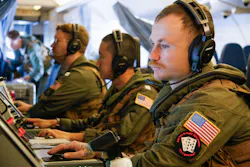
PATUXENT RIVER NAS, Md. – U.S. Navy avionics experts are asking the Boeing Co. to maintain and upgrade flight software aboard the P-8A Poseidon maritime patrol and surveillance aircraft to stave-off the effects of systems obsolescence.
Officials of the Naval Air Systems Command at Patuxent River Naval Air Station, Md., announced a $166.8 million contract in late February to the Boeing Defense, Space & Security segment in Seattle for software upgrades and maintenance on the P-8A -- a Navy maritime patrol and anti-submarine warfare (ASW) aircraft based on the Boeing 737-800 commercial airliner with heavy modifications for military operations.
P-8A Poseidon systems software integrates the aircraft’s mission, sensors, communications, and weapons systems to enable flight crews to detect, track, and attack enemy submarines, surface vessels, and other targets.
The plane's software provides pre-mission route planning and in-flight adjustments; integrates radar, sonar buoys, electronic support measures, and infrared sensors; integrates with torpedoes, anti-ship missiles, and depth charges; combines inputs from several sensors into one tactical picture; and secure data links with other naval systems, satellites, and command centers.
P-8A flight software
P-8A software manages tactical displays, sensor integration, and mission data processing; weapons systems that controls launch, targeting, and guidance for onboard weapons; communications and networking for Link 16, satellite communications, and other tactical data links; and integrated navigation, autopilot, and safety-critical avionics.
The P-8A software is modular to enable updates to add new sensors, weapons, or mission capabilities without overhauling the entire aircraft. Software updates add capabilities like advanced networking, new sensor processing algorithms, or expanded weapons integration.
The plane's software enables submarine detection and tracking using sonobuoys and acoustic processing; surface surveillance and targeting with the AN/APY-10 radar; electronic intelligence gathering; and networked operations for maritime domain awareness.
The P-8A has taken part in naval operations since its initial deployment in 2013. Its systems software is updated incrementally every two to three years, depending on Navy needs and available funding.
Software update schedule
Its software updates follow a block upgrade program that emphasizes basic ASW and mission system functions first, then sensor processing, networking, and weapons integration, and finally improved data fusion, electronic intelligence processing, and expanded mission planning.
Future P-8A software updates are expected to introduce artificial intelligence (AI) processing to address sensor integration and emerging threats.
On this contract Boeing will do the work in Seattle; St. Louis, and Huntington Beach, Calif., and should be finished by December 2030. For more information contact Boeing Defense, Space & Security online at www.boeing.com/defense/patrol-early-warning-and-battle-management/p-8-poseidon, or Naval Air Systems Command at www.navair.navy.mil.
