Trump quantum initiative aligns with industry's push to move quantum technologies beyond the laboratory
Key Highlights
- The U.S. government aims to deploy a powerful quantum computer for scientific research by 2028, with an emphasis on practical applications in national security and communications.
- Boeing's Quantum 4 Space program successfully demonstrated space-qualified entanglement swapping, moving quantum networking closer to operational deployment in space environments.
- Quantum networking technologies could enable highly precise timing, secure communications, and resilient systems across multiple domains, including air, land, sea, and space.
WASHINGTON - President Donald Trump's new executive orders accelerating development of quantum computing, sensing, networking, and cybersecurity technologies come as aerospace and defense companies increasingly focus on a different challenge: transforming promising quantum science into rugged, deployable systems capable of operating in real-world environments.
The administration's directives call for the accelerated development of quantum technologies across the federal government, including efforts to advance quantum computing, quantum networking, and quantum sensing, as well as the transition to post-quantum cryptography. The initiative establishes a goal of deploying a powerful quantum computer for scientific research by 2028 while encouraging agencies to expand development of quantum-enabled capabilities with potential applications in national security, communications, navigation, and scientific research.
While public attention often centers on the race to build practical quantum computers, many aerospace and defense organizations are investing heavily in technologies that could reach operational use sooner, including quantum networking, precision timing, secure communications, and advanced sensing systems.
Related: Cybersecurity challenges grow across connected aircraft and satellite networks
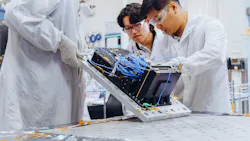
The policy announcement comes less than a week after Boeing, headquartered in Arlington, Va., announced a milestone in its Quantum 4 Space (Q4S) program, which successfully demonstrated high-fidelity entanglement swapping during ground testing of a compact, space-qualified quantum networking payload.
Boeing demonstration
According to Boeing, the payload also completed environmental qualification testing designed to verify that the hardware can withstand launch stresses and operate in the harsh conditions of space. The company said final spacecraft integration is underway ahead of a planned 2027 launch and a one-year orbital demonstration mission.
The significance of Boeing's announcement lies less in the quantum experiment itself than in the engineering challenge of making quantum technologies practical for operational environments.
Many quantum demonstrations are conducted using large, delicate laboratory equipment operating under tightly controlled conditions. Boeing's Q4S effort seeks to demonstrate that a key quantum networking capability can operate on a compact payload engineered to meet the size, weight, power, and reliability constraints of a spacecraft.
Quantum networking
The centerpiece of Boeing's recent demonstration was entanglement swapping, a quantum process that allows quantum links to be extended beyond direct point-to-point connections. Researchers consider the capability a foundational building block for future quantum networking architectures.
Related: Sensor fusion meets edge computing for real-time ops
Boeing says the Q4S mission supports its long-term vision of a global quantum internet that connects quantum sensors, clocks, and computing resources over long distances. Data collected during the orbital demonstration will be used to assess payload performance in space and help inform future quantum networking architectures.
For defense organizations, quantum networking could eventually support a range of applications beyond secure communications. Potential uses include highly precise timing distribution, validation of network integrity, synchronization of distributed systems, and resilient communications architectures operating across air, land, sea, space, and cyber domains.
At the same time, quantum sensing technologies are drawing growing interest from defense planners seeking alternatives to traditional positioning, navigation, and timing systems.
Researchers across government, industry, and academia are investigating quantum-enabled inertial navigation systems that could reduce dependence on satellite navigation, as well as advanced quantum sensors capable of measuring extremely small changes in acceleration, gravity, magnetic fields, and other physical phenomena. Such capabilities could prove valuable in GPS-denied or contested environments where conventional navigation and sensing systems may be degraded or unavailable.
Related: ESA selects SBQuantum for quantum magnetometer prototype
A quantum future
The transition from laboratory science to deployable hardware remains one of the most significant hurdles facing the quantum industry.
Engineering quantum technologies for aerospace and defense applications requires overcoming challenges related to size, weight, power consumption, thermal management, vibration, radiation exposure, manufacturability, and long-term reliability. Components that function in controlled laboratory environments often require substantial redesign before they can survive aboard satellites, aircraft, ships, or ground vehicles.
That challenge is increasingly driving collaboration among federal agencies, research institutions, and aerospace manufacturers as the United States seeks to translate scientific breakthroughs into practical capabilities.
The administration's new quantum initiative suggests policymakers increasingly view quantum technologies as strategic assets with implications for cybersecurity, economic competitiveness, military capability, and critical infrastructure protection.
For aerospace and defense engineers, however, the most immediate impact may come not from future quantum computers but from the steady maturation of quantum networking, sensing, timing, and communications technologies. Programs such as Boeing's Q4S mission offer an early indication of how those technologies may transition from laboratory demonstrations to operational aerospace systems in the years ahead.
About the Author
Jamie Whitney
Editor-in-Chief
Jamie Whitney joined the staff of Military & Aerospace Electronics in 2018 and oversees editorial content and produces news and features for Military & Aerospace Electronics, attends industry events, produces Webcasts, and oversees print production of Military & Aerospace Electronics.
Related
Voice Your Opinion!
To join the conversation, and become an exclusive member of Military Aerospace, create an account today!
 Leaders Logo
Leaders relevant to this article: