U.S. Space Force launches second spacecraft for VICTUS HAZE responsive-space mission
Key Highlights
- The VICTUS HAZE mission involved launching a Rocket Lab Electron rocket from New Zealand to demonstrate rapid spacecraft deployment capabilities.
- On-orbit operations include rendezvous and proximity scenarios to improve space domain awareness and object characterization under operational conditions.
- The mission features advanced optical payloads developed by Lawrence Livermore National Laboratory, designed for quick deployment and ruggedness in space environments.
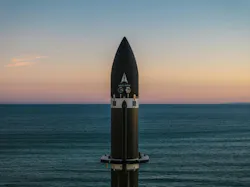
EL SEGUNDO, Calif. - The U.S. Space Force has completed the second launch of its VICTUS HAZE Tactically Responsive Space (TacRS) mission, sending a Rocket Lab Electron rocket into orbit on 19 June from the company's Launch Complex 1 in New Zealand.
The launch completes the mission's responsive-launch demonstration and begins its on-orbit operations phase. VICTUS HAZE is a multi-launch, multi-vehicle demonstration designed to test the military's ability to rapidly acquire, launch, and operate spacecraft in response to urgent on-orbit threats.
The mission now moves into on-orbit operations, where spacecraft developed by Rocket Lab and True Anomaly will conduct rendezvous and proximity operations (RPO) scenarios intended to evaluate space domain awareness and object-characterization capabilities under operationally relevant conditions.
Going online
Following spacecraft checkout and commissioning, operators will begin a series of dynamic engagements involving Rocket Lab's spacecraft and True Anomaly's Jackal vehicle, which launched 3 May aboard a SpaceX Falcon 9 rideshare mission from Vandenberg Space Force Base in California.
One of the key technologies aboard the Rocket Lab spacecraft is an optical space-domain-awareness payload developed by Lawrence Livermore National Laboratory (LLNL). The payload uses the laboratory's monolithic telescope technology, which is manufactured from a single piece of fused silica rather than multiple aligned optical components. According to LLNL, the design significantly reduces post-manufacturing optical alignment requirements while maintaining imaging performance suitable for object characterization missions.
The laboratory says the ruggedized architecture is particularly suited to responsive-space missions because it can withstand launch environments and become operational shortly after reaching orbit. The payload is designed to support space-domain awareness and object characterization missions, capabilities that align with the objectives of the VICTUS HAZE demonstration.
The mission is being led by Space Systems Command's Space Safari office, part of System Delta 89.
"VICTUS HAZE culminates the TacRS 'crawl, walk, run' phase of on-orbit demonstrations," said Lt. Col. Lincoln Miller, Space Safari system program manager. "We are confident in the technology and space operations expertise of our teams, who have paved the way for rapid capability delivery to orbit in support of urgent operational needs."
Mission goals
According to the Space Force, the mission is intended to demonstrate the ability to rapidly acquire, launch, and operate spacecraft in response to urgent on-orbit threats while relying heavily on commercially developed spacecraft, launch services, and supporting technologies.
The Rocket Lab spacecraft will rendezvous with True Anomaly's Jackal spacecraft. Prior to launch, the Space Safari office placed Rocket Lab on heightened readiness and later directed the company to prepare for launch to a previously unspecified orbit with only 24 hours' notice.
The activation process from readiness to alert status took less than 48 hours, according to the Space Force.
Miller said the mission provides an opportunity for operators to develop and refine tactics, techniques, and procedures for low-Earth-orbit rendezvous and proximity operations while helping establish a foundation for future responsive-space missions.
"Not only does this mission open the door for acquisition of follow-on vehicles that allow our warfighters to close critical gaps and seams in a conflict scenario, it also presents a more immediate value by giving our current operators a crucial opportunity to exercise and improve LEO RPO tactics, techniques, and procedures," Miller said.
Space Force officials said acquisition efforts supporting VICTUS HAZE were designed to enable rapid production and deployment of follow-on spacecraft from either Rocket Lab or True Anomaly for future responsive-space operations.
The mission also included contributions from the Defense Innovation Unit, which supported the Rocket Lab effort through its Commercial Solutions Opening process, and SpaceWERX, which supported True Anomaly through a Strategic Funding Increase award. Additional mission partners include Lawrence Livermore National Laboratory, the Space Domain Awareness Tools, Applications and Processing Lab under System Delta 85, and The Aerospace Corporation.
About the Author
Jamie Whitney
Editor-in-Chief
Jamie Whitney joined the staff of Military & Aerospace Electronics in 2018 and oversees editorial content and produces news and features for Military & Aerospace Electronics, attends industry events, produces Webcasts, and oversees print production of Military & Aerospace Electronics.
Related
Voice Your Opinion!
To join the conversation, and become an exclusive member of Military Aerospace, create an account today!
 Leaders Logo
Leaders relevant to this article: