Space Force awards $4.16 billion SB-AMTI contract to SpaceX for space-based airborne tracking
Key Highlights
- The SB-AMTI program aims to establish a persistent, global space-based system for tracking airborne threats, supplementing traditional surveillance methods.
- Expected to deploy a satellite constellation by 2028, the system will enhance battlespace awareness and reduce vulnerabilities of airborne surveillance assets.
- The initiative involves advanced radar, AI-enabled data fusion, resilient communications, and distributed processing to overcome technical challenges in space-based target tracking.
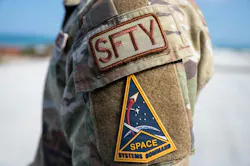
WASHINGTON - The U.S. Space Force announced it has issued a $4.16 billion competitive Other Transaction Authority (OTA) agreement to SpaceX in Starbase, Texas, for the Space-Based Airborne Moving Target Indicator program, an effort to establish a persistent global space-based capability for tracking airborne threats.
The Space-Based Airborne Moving Target Indicator, or SB-AMTI, program is intended to augment traditional airborne surveillance and tracking platforms as adversaries continue developing increasingly sophisticated anti-access/area-denial capabilities that threaten conventional airborne sensing architectures.
Currently, airborne moving target indication missions are conducted primarily by crewed surveillance aircraft operating in or near contested environments. The Space Force initiative seeks to shift portions of that mission into proliferated low-Earth-orbit satellite constellations capable of maintaining continuous battlespace awareness while reducing reliance on vulnerable airborne assets.
System of systems
SB-AMTI is designed as a distributed system-of-systems architecture integrating space-based sensors, resilient communications links, secure data transport, and ground processing infrastructure. The architecture is intended to provide persistent sensing and tracking of airborne targets worldwide while contributing data into broader Joint All-Domain Command and Control operational networks.
"By focusing these capabilities to the space domain, we are providing the Joint Force with sustained battlespace awareness of contested airspace," said U.S. Space Force Col. Ryan Frazier, acting portfolio acquisition executive for Space Based Sensing & Targeting.
Frazier said development and integration work will begin immediately to support rapid deployment timelines and emerging national security requirements.
While technical details remain limited, the program is expected to incorporate advanced radar sensing technologies, distributed processing, high-speed tactical communications, and artificial intelligence-enabled data fusion to maintain custody of airborne targets from orbit. Tracking moving airborne targets from space presents major technical challenges involving revisit rates, Doppler discrimination, latency, clutter filtering, and target handoff between satellites across large operational areas.
Rapid integration
The Space Force has emphasized rapid acquisition and commercial integration throughout the program, reflecting a broader shift toward leveraging mature commercial low-Earth-orbit manufacturing, launch, networking, and space transport capabilities instead of relying exclusively on traditional large strategic satellite architectures.
Related: ICEYE launches six SAR satellites for sovereign intelligence and Earth observation missions
To execute the effort, the Space Force is using a hybrid acquisition model that combines the flexibility of an OTA agreement with the scalable ordering structure of an indefinite-delivery/indefinite-quantity contracting approach. Officials also established a multi-company SB-AMTI vendor pool intended to incorporate technologies from both traditional defense contractors and non-traditional commercial suppliers.
Frazier said the strategy is intended to prevent reliance on a single provider while maintaining access to a competitive industrial base capable of rapidly fielding emerging technologies.
Additional awards
The Space Force expects to issue additional awards over the next year to expand the SB-AMTI vendor base and accelerate capability delivery to combatant commanders. Officials project the initial award will support deployment of a satellite constellation by 2028 to provide early operational capability and reduce airborne surveillance blind spots.
Space Systems Command is the U.S. Space Force field command responsible for acquiring, developing, and delivering military space capabilities. The organization manages approximately $15.6 billion annually in space acquisition programs for the Department of Defense.
About the Author
Jamie Whitney
Editor-in-Chief
Jamie Whitney joined the staff of Military & Aerospace Electronics in 2018 and oversees editorial content and produces news and features for Military & Aerospace Electronics, attends industry events, produces Webcasts, and oversees print production of Military & Aerospace Electronics.
Related
Voice Your Opinion!
To join the conversation, and become an exclusive member of Military Aerospace, create an account today!
 Leaders Logo
Leaders relevant to this article: