DoD signs framework agreements to expand PAC-3, THAAD interceptor production capacity
Key Highlights
Engineering context
The agreements establish an additional production source for PAC-3 MSE solid rocket motors while expanding manufacturing of THAAD structural assemblies. These components represent two of the specialized manufacturing processes in interceptor production and are intended to support higher production rates.
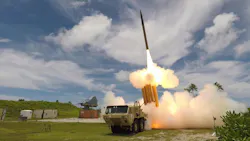
WASHINGTON - The Department of Defense (DoD) has signed two framework agreements with Northrop Grumman, in coordination with Lockheed Martin, to expand production capacity for critical propulsion and structural components supporting Patriot Advanced Capability-3 Missile Segment Enhancement (PAC-3 MSE) and Terminal High Altitude Area Defense (THAAD) interceptors.
According to DoD, the agreements are intended to support a threefold increase in PAC-3 interceptor production and a fourfold increase in THAAD production by providing long-term demand signals to critical suppliers, enabling investments in manufacturing capacity, workforce development, facility modernization, and supply-chain resilience.
Unlike traditional procurement contracts managed primarily through prime contractors, the framework agreements reflect a broader acquisition strategy in which DoD establishes direct relationships with critical suppliers to strengthen the missile industrial base and expand production capacity for essential interceptor components.
Related: Lockheed Martin introduces PAC-3 ACE interceptor, MORFIUS X-Rotor counter-UAS system
One agreement establishes a second source for PAC-3 MSE solid rocket motors while increasing production of ignition safety devices. Solid rocket motors are among the most technically demanding components of modern missile systems, requiring specialized propellant manufacturing, composite case fabrication, precision casting, and extensive qualification testing. Establishing an additional source is intended to reduce supply-chain bottlenecks while increasing production resilience.
Hit-to-kill
PAC-3 MSE is a hit-to-kill interceptor that destroys incoming ballistic missiles through direct kinetic impact rather than a fragmentation warhead. That approach places stringent demands on propulsion, guidance, maneuverability, and precision manufacturing, making rocket motor production a critical element of the interceptor's performance.
A second framework agreement focuses on expanding production of THAAD interceptor structural components, including mid-body shells, muzzle covers, and rail car assemblies. These aerospace structures must withstand the mechanical loads, thermal stresses, and high-G forces encountered during launch and intercept while maintaining tight dimensional tolerances.
Like PAC-3 MSE, THAAD uses hit-to-kill technology to intercept short-, medium-, and intermediate-range ballistic missiles during the terminal phase of flight, including engagements outside the atmosphere when engagement geometry permits. The system's reliance on direct kinetic impact similarly places demanding requirements on missile guidance, propulsion, and structural integrity.
Financial background
Northrop Grumman said the framework agreements are valued at more than $3 billion over multiple years, including approximately $2 billion supporting PAC-3 MSE solid rocket motors and ignition safety devices and approximately $1 billion to increase THAAD component production over seven years.
The company said it has invested more than $2 billion in munitions technologies and manufacturing facilities since 2019, including more than $1 billion dedicated to solid rocket motor production. Northrop also said it has doubled tactical solid rocket motor production capacity at its Allegany Ballistics Laboratory in Rocket Center, W.Va., since 2021 and expects to triple production capability there by 2027. The company is also expanding solid rocket motor production capacity at facilities in Promontory, Utah, and Elkton, Md.
DoD said the agreements support its Acquisition Transformation Strategy and were developed in coordination with the Missile Defense Agency, the Munitions Acceleration Council, the Economic Defense Unit, and the Office of the Under Secretary of Defense for Acquisition and Sustainment.
About the Author
Jamie Whitney
Editor-in-Chief
Jamie Whitney joined the staff of Military & Aerospace Electronics in 2018 and oversees editorial content and produces news and features for Military & Aerospace Electronics, attends industry events, produces Webcasts, and oversees print production of Military & Aerospace Electronics.
Related
Voice Your Opinion!
To join the conversation, and become an exclusive member of Military Aerospace, create an account today!
 Leaders Logo
Leaders relevant to this article: