BAE Systems integrates embedded training system on Army Bradley vehicles
Key Highlights
- The ECT system is the first commercially available embedded trainer installed in U.S. Army combat vehicles, starting with the Bradley Fighting Vehicles.
- It connects to Bohemia Interactive's VBS4 environment, enabling shared virtual training scenarios for vehicle crews and instructors.
- The architecture supports scaling from individual crew training to platoon-level tactical scenarios and can extend to other vehicle types.
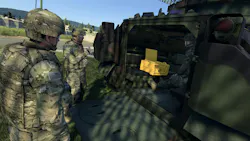
FORT HOOD, Texas - BAE Systems OneArc is integrating its Embedded Collective Training (ECT) system onto a platoon of U.S. Army combat vehicles at Fort Hood as part of the Army's Force Development Innovation & Assessment (FDIA) effort.
BAE Systems OneArc received an Other Transaction Agreement contract from the Army to integrate it. The company says the effort represents the first commercially available embedded trainer installed in a U.S. Army combat vehicle.
The initial ECT implementation focuses on M2A3/4 Bradley Fighting Vehicles. The U.S. Army has shown soldiers from the 1st Cavalry Division testing the system at Fort Hood, describing it as a capability that lets crews simulate Bradley gunnery tables inside their vehicles at the range or in the motor pool.
In position
ECT brings synthetic training into the vehicle, allowing mounted crews to train from their normal crew positions using familiar interfaces, controls, sensors, and procedures. OneArc says the system connects the vehicle to Bohemia Interactive Simulations' VBS4 virtual training environment, allowing crews to operate in a shared synthetic environment while instructors manage scenarios from an administrator station.
During FDIA, Army crews are training on precision gunnery progression tasks in support of platform qualification, including crew-level qualification and validation of the embedded training capability on a fielded combat platform.
The approach is intended to reduce reliance on fixed simulator facilities and live-fire ranges for some training activities. Because the training system is integrated into the operational vehicle, crews can conduct repetitions using the platform's own controls and procedures without moving to a dedicated simulator.
OneArc says its ECT architecture is designed to scale from individual crew training to collective scenarios, including platoon-level training and distributed tactical maneuver. The company also says the architecture can accommodate additional vehicle variants and extend to other crewed and uncrewed ground platforms.
For distributed training, OneArc identifies Pitch as the interoperability layer that connects simulation systems and synchronizes data and events. The company says the architecture can provide a path from local vehicle training to larger live, virtual, and constructive training environments.
BAE Systems says the Army's commercial-first approach to training is intended to reduce development time for integrating training capabilities with newly fielded equipment and shorten the transition from acquisition to training from years to months.
