Argonaut lunar lander consortium introduced by ESA
Questions and Answers:
What is Argonaut? Argonaut is ESA's lunar lander designed to transport scientific payloads, supplies, and equipment to the Moon.
Who is leading the industrial team? Thales Alenia Space in Italy serves as prime contractor and leads the international consortium.
What will Argonaut deliver? It can carry up to 1500 kilograms of cargo, including supplies for astronauts, rovers, instruments, and lunar infrastructure.
COLOGNE, Germany - The European Space Agency (ESA) presented the Thales Alenia Space Italy-led consortium for its lunar lander program, Argonaut, at a press conference held at the European Astronaut Centre in Cologne, Germany. Thales Alenia Space in Italy, the prime contractor, has signed agreements with Thales Alenia Space in France, OHB AG in Bremen, Germany, Thales Alenia Space in the UK, and Nammo Space in the UK.
The consortium is responsible for the design, development, and production of the Argonaut Lunar Descent Element, the transport element of Argonaut, which will offer Europe autonomous access to the lunar surface. ESA officials said the state-of-the-art technology will support studies of the Moon, de-risk key technologies, and pave the way for human exploration.
Argonaut will also support the National Aeronautics and Space Administration's (NASA) Artemis program. The European lander can transport cargo, including food, water, air, rovers, science instruments, and infrastructure for communication and power generation.
Related: DLR researchers test sensors and robotic systems for lunar water-ice detection
Argonaut components
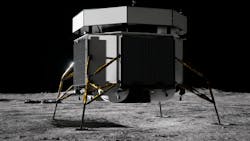
Argonaut consists of the Lunar Descent Element, the Cargo Platform Element, and the payload. The lander stands six meters high, measures 4.5 meters in diameter, and has a launch mass of nearly 10,000 kilograms. It can deliver about 1,500 kilograms to the lunar surface and is designed to land within 250 meters of its target. It is built to survive lunar night temperatures of minus 150 degrees Celsius and darkness lasting up to 14 days. The first mission is planned for launch in 2030 on an Ariane rocket.
"The creation of this consortium led by Thales Alenia Space represents a significant milestone in this challenging Argonaut mission," said Giampiero Di Paolo, Deputy CEO and Senior Vice President, Observation, Exploration and Navigation at Thales Alenia Space. "Under the leadership of the European Space Agency and alongside the consortium partners, Thales Alenia Space is playing a pioneering role to enable the European autonomous access to the Moon."
"A European presence on the Moon is a vision we at OHB have been working toward for many years. We are thrilled to play a pivotal role in this mission by contributing essential subsystems to the Argonaut LDE, helping to further advance Europe's space exploration capabilities," said Chiara Pedersoli, CEO of OHB System AG.
"We are extremely proud to team up with ESA and the consortium partners in providing the Data Handling Sub-System that will play a key role in the landing phase of Argonaut’s Lunar Descent Element," said Yvan Baillion, Director of European Business at Thales Alenia Space. "Lunar exploration if of great importance to our company and our teams in France are glad to bring also their expertise to the Gateway cis-lunar space station by developing the Lunar View and Lunar Link modules and being a major contributor of the Habitat module."
Consortium roles
• Thales Alenia Space in Italy: prime contractor and system integrator for the Lunar Descent Element, including assembly, integration, and testing.
• Thales Alenia Space in France: responsible for the Data Handling Sub-System, middleware software, and on-board computers procurement.
• Thales Alenia Space in the UK: responsible for propulsion subsystem development and procurement of propellant tanks and thrusters.
• OHB System AG: responsible for GNC, electrical power systems, telecommunications, and procurement of solar arrays, batteries, lidar, and transponders.
• Nammo Space: responsible for the design and procurement of the main engine.
About the Author
Jamie Whitney
Editor-in-Chief
Jamie Whitney joined the staff of Military & Aerospace Electronics in 2018 and oversees editorial content and produces news and features for Military & Aerospace Electronics, attends industry events, produces Webcasts, and oversees print production of Military & Aerospace Electronics.
Related
Voice Your Opinion!
To join the conversation, and become an exclusive member of Military Aerospace, create an account today!
 Leaders Logo
Leaders relevant to this article: