From highway to high-threat: How software-defined vehicles are reshaping military systems

KLEIN-WINTERNHEIM, Germany - The global high-tech landscape is witnessing a profound convergence: The automotive industry, driven by rapid advances in Software-Defined Vehicles (SDVs), is becoming a critical force in modernizing defense platforms. This bold trend - Automotive Goes Defense - is far more than a simple transfer of parts; it represents a paradigm shift in which automotive engineering practices, stringent safety architectures, and sophisticated embedded software are now the linchpins for building agile, robust, and secure military systems.
For OEMs, software engineers, certifiers, and CEOs in critical markets, understanding this convergence is essential for maintaining both commercial competitiveness and strategic sovereignty. As modern military systems become more software-defined, defense can learn from the automotive sector, which has spent many years solving challenges in technologies such as software modularity, real-time systems, autonomy, sensor fusion, and over-the-air updates. Defense platforms are now adopting these same software-defined architectures, increasing the need for secure, certifiable platforms capable of safely consolidating mixed-criticality functions.
Why defense is turning toward automotive
Vehicles deployed in modern military logistics, reconnaissance, or autonomous combat roles are increasingly defined by software's ability to adapt. The defense sector is looking to the automotive industry for three core capabilities: High-volume production reliability, embedded software excellence, and rapid iteration (agility).
Recent strategic alliances dramatically illustrate this synergy. The collaboration between Daimler Truck and the French defense firm Arquus on tactical military vehicles, such as the Arquus Zetros, demonstrates how proven, high-reliability commercial chassis and high-volume production capabilities can be seamlessly augmented with military-grade integration, protection, and in-service support. This partnership is a model for strengthening the European defense industrial and technological base (Link).
Related: Reliable Robotics completes FAA contract for detect-and-avoid data collection flights
Meanwhile, automotive supplier Schaeffler has begun exploring a deeper entry into defense, particularly around integrated hardware-software systems. This market-driven shift shows that defense contractors recognize the inherent value of automotive-grade mechatronics and software stacks validated through mass-market rigor.
The core value proposition lies in leveraging the cost efficiency and developmental velocity of the automotive SDV paradigm to accelerate defense modernization and address the urgent need for flexible, mission-ready platforms. Modern military platforms now face many of the challenges already encountered in the automotive SDV transition – from integrating multiple critical systems, to managing real-time data processing and ensuring safety and cybersecurity. Consequently, defense programs are increasingly adopting software-centric architectures and compute platforms originally matured within automotive environments, enabling the secure consolidation of autonomous, real-time, and mixed-criticality functions onto shared systems.How automotive SDV architectures translate into defense platforms
Once defense platforms adopt SDV principles, the impact extends beyond software updates or connectivity alone. Modern military systems increasingly require modular software environments, real-time processing, secure consolidation of multiple workloads, and autonomous capabilities. These demands can be met through several architectural approaches pioneered in the automotive space.
Over-The-Air (OTA) readiness, for example, is a well-proven approach to software adaptability, providing a flexible means of updating computer system software through wireless communication. Similar to how consumer vehicles receive feature upgrades, military platforms can utilize secure OTA updates to deploy mission-specific software, recalibrate sensor suites, and adapt payload control systems instantly.
Supporting this level of adaptability, however, requires increasingly modular software architectures. Hardware-agnostic, modular software, such as that promoted by Mercedes-Benz's SDV philosophy, offers the flexibility critical for defense logistics and combat vehicles operating in diverse and unpredictable operational theaters.
As military platforms become increasingly software-defined, an increasing number of critical and non-critical workloads must coexist on shared hardware. This creates major challenges around safety, cybersecurity, determinism, and workload isolation. Defense systems therefore require architectures capable of securely partitioning and managing multiple functions simultaneously.
Indeed, military vehicles face a unique challenge: integrating mission-critical functions (e.g., weapon control, encrypted communications) with safety-critical operations (e.g., braking, diagnostics) onto a single compute platform while guaranteeing isolation. To manage these requirements, automotive-grade embedded systems utilize certified Real-Time Operating Systems (RTOS), and hypervisors can create strictly partitioned domains. This allows functions with different safety and security integrity levels to run concurrently and securely on shared hardware, minimizing the risk of a non-critical system failure or a cyber breach compromising the core mission.
Once secure software-defined foundations are established, they enable increasingly advanced autonomous and AI-driven capabilities. Real-time sensor processing, perception, and decision-making have now become possible at the Edge. These capabilities are especially important in contested or disconnected environments where systems must operate autonomously.
Within these software-defined environments, Edge AI is becoming central to real-time perception, autonomous response, and battlefield awareness. Edge AI, running on secure, deterministic systems, enables real-time sensor fusion, image recognition, and predictive maintenance—vital for autonomous target acquisition or real-time anomaly detection in the field. This capability is deployed using cloud-edge hybrid architectures, a model perfected in the latency-sensitive automotive domain.
Increasing autonomy also creates major validation challenges. Mission software must be tested rapidly and safely before deployment. Automotive SDV development has already pioneered virtualized validation approaches that accelerate this process. Extensive use of Digital Twins, virtualized test benches, and Cloud-Native CI/CD toolchains allows defense integrators to simulate complex battlefield scenarios, validate mission software quickly, and ensure deployment accuracy before physical hardware is committed.
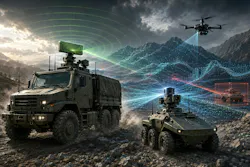
One of the most mature and transferable technology domains between automotive and defense is environmental perception. Advanced Driver Assistance Systems (ADAS) and autonomous driving stacks rely heavily on multi-modal sensor fusion—combining radar, LiDAR, cameras, and ultrasonic sensors—to create a real-time, high-fidelity model of the vehicle’s surroundings.
In defense applications, similar requirements exist, albeit under more extreme and adversarial conditions. Military vehicles must operate in low-visibility environments (dust, fog, smoke), under GPS-denied conditions, and in scenarios where obstacles may be dynamic, unpredictable, or intentionally concealed. Automotive-grade perception systems, refined through millions of kilometers of real-world driving data, provide a strong technological baseline for such use cases.
Key transfer aspects include:
Radar Systems for Robust Detection: Automotive radar has evolved significantly in range, resolution, and object classification capabilities. These systems are inherently robust to weather and lighting conditions, making them well-suited for defense scenarios such as convoy operations, perimeter monitoring, and collision avoidance in degraded environments.
LiDAR for High-Resolution Mapping: LiDAR enables precise 3D mapping and object detection, supporting navigation in complex terrains. While automotive-driven scale and innovation have traditionally been cost-prohibitive, they are rapidly improving affordability and performance, opening new opportunities for defense reconnaissance and autonomous navigation.
Sensor Fusion and AI-Based Perception: The true strength lies in combining multiple sensor modalities through AI-driven fusion algorithms. Automotive systems already integrate radar, LiDAR, and camera data to improve accuracy and redundancy—an approach directly applicable to mission-critical defense platforms where reliability and fault tolerance are paramount.
Edge Processing on Safety-Critical Platforms: Processing sensor data in real time requires high-performance, deterministic computing platforms. Here, certified RTOS and hypervisor platforms enable the safe and secure execution of perception algorithms alongside other mission-critical functions, ensuring both real-time responsiveness and system integrity.
Redundancy and Functional Safety: Automotive safety standards (e.g., ISO 26262) have driven the development of redundant sensing architectures. These concepts translate well into defense, where fail-operational behavior is essential for mission success and personnel safety.
Overall, perception systems represent a critical enabler for autonomous and semi-autonomous defense vehicles. By leveraging automotive advancements in sensing and sensor fusion, defense platforms can achieve greater situational awareness, operational safety, and mission effectiveness.
PikeOS: The Certified Bridge Between Domains
Achieving the convergence of automotive agility and defense robustness demands a foundation of absolute safety and security. SYSGO's PikeOS fulfills this requirement by serving as a certified bridge.
PikeOS is a certified RTOS and hypervisor built upon a separation kernel architecture. It enables the consolidation of diverse, high-assurance code—from vehicle diagnostics (ISO 26262) to encrypted communications (Common Criteria)—on a single hardware platform. This separation and containment are non-negotiable for defense, where hardware failure or a cyberattack cannot compromise the vehicle’s mission.
It is explicitly designed to meet stringent industry standards across sectors, including ISO 26262 for automotive, and DO-178C for avionics/defense. This modular approach to certification is critical: it enables modular certification scopes, allowing new mission features to be updated or added without re-certifying the entire system stack, drastically improving time-to-deployment in an evolving threat landscape.
Related: Army seeks autonomous technologies for uncrewed vehicle recovery missions
By consolidating multiple functions onto fewer processing units through virtualization, PikeOS significantly reduces the Size, Weight, and Power (SWaP) requirements—a critical boon for defense vehicles operating under severe mass, energy, and cooling constraints. Furthermore, the RTOS's guaranteed determinism ensures that Edge AI and critical control loops operate reliably in real time.
Toward the next generation of defense platforms
With defense platforms becoming more software-defined, the convergence between automotive and defense is reshaping not only vehicle architectures, but also the wider development and industrial ecosystem surrounding them. This shift is driving new approaches to collaboration, software development, certification, and strategic infrastructure control across both sectors.
Automotive OEMs and Tier-1 suppliers must actively build formalized ecosystems with defense integrators (following the model of Daimler Truck and Arquus). This collaboration must extend beyond hardware supply to align software stacks, validation practices, and scalable production capabilities.
The automotive industry has shifted rapidly from individual, hardware-coupled development to a software-first design philosophy. This change, which emphasizes abstraction layers via RTOS, virtualization, and digital twins, provides the blueprint for simplifying complex, heterogeneous defense architectures.
Cloud environments are now an integral part of the embedded development lifecycle. Automotive teams leverage large-scale CI/CD pipelines, simulation, and virtual testing within the cloud. The defense sector can adopt these practices to streamline validation, accelerate testing throughput, and significantly reduce time to field deployment for mission software.
Engineering teams must transition to a dual-compliance model that seamlessly aligns development rigor with both civilian safety standards (e.g., ISO 26262) and relevant defense/security standards (e.g., Common Criteria). Platforms built on certified foundations, like PikeOS, are essential for simplifying this complex compliance burden.
Meanwhile, Europe's proactive push for sovereignty in the semiconductor supply chain and trusted cloud infrastructure directly mirrors defense's existential need for controllable, trusted domains. The defense sector requires the ability to audit, control, and evolve its core compute platforms and RTOS technologies without reliance on external, potentially contested, providers.
Future Outlook: the resilient vehicle system
Looking further ahead, the fusion of automotive software practices and defense requirements is set to drive several transformative outcomes. The rise of autonomous defense platforms, for instance, is a highly relevant trend. The validated technology stack from autonomous cars—including Lidar fusion, complex path planning, and dynamic decision-making—will inevitably migrate into Unmanned Ground Vehicles (UGVs), military drones, and robotic convoys, enhancing mission endurance and reducing risk to personnel.
AI-powered threat response is also an area of intense research and development and deployable innovation in the field. Edge AI running on real-time, secure systems (such as those enabled by PikeOS) will facilitate real-time threat detection and reactive defense mechanisms, integrated directly into automotive-derived platforms.
The emergence of SDV inevitably focuses attention on cyber-resiliency. The automotive industry’s increasing focus on cybersecurity (e.g., compliance with ISO/SAE 21434) will fundamentally bolster defense systems’ resilience, ensuring that complex software-defined platforms are securely safeguarded against increasingly sophisticated cyber threats. Defense-grade OTA ecosystems will also become more relevant. This will be characterized by secure, segmented OTA architectures that enable the safe, rapid, and authenticated update of mission-critical modules, minimizing downtime and logistical overhead during operations.
Hardware innovation should also not be overlooked. Consolidated SWaP in field deployments will result in hardware consolidation achieved through virtualization and hypervisors, which will result in lighter, more energy-efficient defense vehicles, where software adaptability effectively compensates for reduced hardware diversity and complexity.
Finally, ecosystem synergies will fuel innovation. The deepening collaboration across OEMs, Tier-1s, specialized software providers, and defense integrators will establish a new ecosystem—one focused on rapidly iterating certified, mission-adapted software platforms capable of meeting the dynamic challenges of the modern security environment.
Emerging concepts such as cooperative and swarm-based vehicle behavior - already explored in fleet and traffic systems - may further extend into coordinated autonomous defense platforms.
Conclusion: Automotive to Defense continues to accelerate
The trajectory of 'Automotive going Defense' illustrates how software-defined innovation, embedded system technologies, and agile development practices from the automotive sector are fundamentally reshaping defense platforms. Strategic partnerships—like Daimler Truck's with Arquus—and automotive suppliers exploring defense avenues demonstrate the viability of this path.
At the heart of this transformation lie certified, multi-domain RTOS and hypervisors such as SYSGO's PikeOS, enabling safe, secure, and modular platforms that effectively bridge automotive agility and defense-grade robustness. As both sectors converge, we expect to see more interoperable architectures, ubiquitous edge AI deployment, enhanced OTA capabilities, and sovereign infrastructures tailored for mission-critical environments.
For software engineers, OEMs, Tier-1 suppliers, and defense leaders, this convergence presents a profound opportunity: to co-develop the next generation of secure, adaptable, and resilient vehicle systems that serve in peace and in conflict—driven by code, validated by rigor, and hardened by defense demands.