Rethinking military batteries: researchers eye non-rigid energy storage for uncrewed and wearable systems
Key Highlights
Questions and answers:
- What is DARPA’s Promethean Clay program trying to develop? Non-rigid, flexible batteries using mechanical and chemical co-design to eliminate heavy, rigid exoskeletons while improving safety, thermal resilience, and energy density.
- What military systems could benefit from flexible batteries? Electric and hybrid tactical vehicles, uncrewed land, sea, and air systems, high-altitude aircraft, satellites, directed-energy weapons, soldier-worn electronics, forward-deployed microgrids, and all-electric surface warships.
- How could flexible batteries improve military operations? Extend vehicle range and endurance without adding weight, enable more compact high-power weapons, reduce logistics burdens such as fuel convoys and battery shipments, and integrate directly into structures like vehicles, aircraft, and wearable gear.
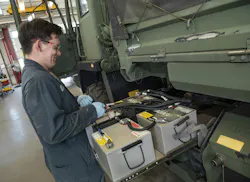
ARLINGTON, Va. – U.S. military researchers are asking industry to develop non-rigid batteries flexible enough to integrate structurally into land vehicles, uncrewed systems, wearable electronics, and all-electric surface warships, while enhancing safety and thermal management.
Officials of the U.S. Defense Advanced Research Projects Agency (DARPA) in Arlington, Va., has issued a solicitation (DARPA-PS-26-16) for the Promethean Clay program to develop flexible energy storage with enhanced thermal resilience and safety.
Promethean Clay seeks to rethink energy storage devices through a mechanical and chemical co-design to eliminate the need for today's rigid, heavy battery exoskeletons.
This kind of flexible battery could integrate structurally into aerospace and defense systems like electric and hybrid tactical vehicles; uncrewed land, sea, and air systems; high-altitude uncrewed aircraft; orbiting satellites; directed-energy and electromagnetic weapons; wearable electronics; forward-deployed microgrids; and all-electric surface warships.
Military applications
For land vehicles, these flexible batteries could significantly extend range and endurance without increasing weight or compromising mobility. Uncrewed vehicles could carry more energy in less mass to extend endurance, payload capacity, or time on station.
Flexible, high-capacity batteries could help uncrewed aircraft and orbiting satellites stay aloft longer, and enable more power without adding launch mass. These batteries also could enable high-power laser and microwaves weapons emit bursts of large amounts of energy, and make these systems more compact and fieldable.
Such batteries could be integrated into soldier-worn gear or armor, and support special forces electronics, communications, sensors, or mobile command posts in austere environments without frequent resupply.
Improved energy storage also could help stabilize forward-deployed electrical microgrids, support wind and solar power generation, and reduce reliance on fuel convoys. Lighter and more compact energy storage means fewer battery shipments and easier handling in remote regions.
Overcoming rigidity
Promethean Clay aims to redesign energy storage using mechanical and chemical co-design to overcome the rigidity imposed by today's electrical batteries, and would demonstrate the ability to operate without the need for external pressure.
Contractors will design material interfaces that remain mechanically and chemically stable during operation, and ensure uniform mechanical properties within the materials in the device. The properties of packaging materials will be simplified from rigid to hermetic to enable designs that can significantly reduce system mass.
Reducing the need for rigidity also could enable batteries to overcome today's commercial scaling processes, with significantly higher performance that scales to different form factors and sizes. Domestic sourcing pathways will be required.
Reduced packaging
Promethean Clay is a four-year program with three phases. The first two-year phase will demonstrate an energy storage framework as a co- designed power source that brings together safety, reduced packaging, and practical energy density.
The second one-year phase focuses on systems integration, while the third one-year phase focuses on application feasibility and a design that overcomes rigid packaging.
Companies interested should submit abstracts no later than 11 March 2026, and proposals no later than 22 April 2026 to the DARPA BAA Tool online at https://baa.darpa.mil.
Email questions or concerns to DARPA at [email protected]. More information is online at https://sam.gov/workspace/contract/opp/0302f8f0fba045619ea4427b128d6f3d/view.
