Chariot wins $7.6 million DIU contract for Army tactical power systems
Key Highlights
- Chariot Defense's Amphora system is designed to manage bidirectional power flows, integrating various energy sources for military use.
- The $7.6 million contract aims to deploy Amphora systems to U.S. Army brigades within 12 months, starting this fall.
- Amphora reduces reliance on large generators, lowering signatures and logistical burdens in high-threat environments.
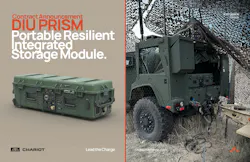
SAN BRUNO, Calif. - Chariot Defense has won a $7.6 million contract from the Defense Innovation Unit (DIU) under the Portable Resilient Integrated Storage Module (PRISM) program to deliver its Amphora power systems to U.S. Army brigades, as the Department of Defense (DoD) seeks more flexible ways to generate, store, and distribute electrical power in contested environments.
Chariot said that the 12-month effort will begin deploying Amphora systems to Army brigades this fall. The company describes Amphora as a bidirectional power-management and distribution system that can integrate tactical generators, solar arrays and military vehicles with energy storage and electrical loads.
The award follows a DIU effort to address limitations in battlefield electrical power. In its March 2026 PRISM solicitation, DIU said the military's existing approach to battlefield electrical energy was fragmented and vulnerable to targetable signatures and strained supply lines in contested-logistics environments. DIU sought flexible, scalable, and portable energy-storage, power-conversion, and distribution systems that could reduce reliance on large generators.
Fielding power
The requirement reflects a growing power-management challenge for distributed military formations. Uncrewed aircraft, electronic-warfare systems, sensors, communications equipment, and computing systems add electrical loads to units that have traditionally relied heavily on generators for expeditionary power.
Related: How rising electrical loads are rewriting the rules of military aircraft design
Chariot says Amphora is designed to provide an intelligent power-management layer between available energy sources and tactical loads. The system can store electrical energy and manage bidirectional power flows, allowing units to reduce generator use while maintaining power to connected equipment.
The company's public materials describe Amphora as a distributed tactical microgrid technology intended to reduce reliance on generators and lower signatures in high-threat environments. Chariot also identifies applications including communications and counter-uncrewed-aircraft systems.
Chariot has cited reductions in fuel consumption and extended periods of silent operation for Amphora, but the performance figures in its current contract announcement should be treated as company-reported claims until additional information is available on test conditions, power loads, and baselines.
Powering the mission
The PRISM effort is part of a broader DoD push to improve expeditionary energy resilience. DIU's solicitation said existing commercial generators are not specifically designed for combat scenarios and can create additional logistical burdens, including dependence on fuels that may not align with battlefield fuel requirements. The solicitation called for commercially developed systems that could be adapted for military use and evaluated through an iterative prototype process.
Related: Sensor technology: The next evolution in an environment of advancing threat capabilities
Chariot is also a finalist in the Army's xTech|Adaptive Strike competition, where its Amphora system is listed under the challenge topic of power generation for ground units with small uncrewed aircraft systems. The Army's competition includes Soldier evaluations, with the final exercise scheduled for October-November 2026.
The Chariot award is not the only publicly announced PRISM selection. Australian battery technology company 3ME Technology said that DIU selected its EdgeVOLT portable energy-storage system for the PRISM prototype program. The separate selection indicates that DIU is evaluating multiple approaches to the battlefield energy-storage requirement.
For Chariot, the PRISM contract provides a near-term path to Army field evaluation of a power architecture intended to support increasingly distributed and electrically dependent forces. The company's technology aims to manage power availability and distribution as units incorporate additional uncrewed systems, sensors, communications, and other electrical loads.
About the Author
Jamie Whitney
Editor-in-Chief
Jamie Whitney joined the staff of Military & Aerospace Electronics in 2018 and oversees editorial content and produces news and features for Military & Aerospace Electronics, attends industry events, produces Webcasts, and oversees print production of Military & Aerospace Electronics.
Related
Voice Your Opinion!
To join the conversation, and become an exclusive member of Military Aerospace, create an account today!
 Leaders Logo
Leaders relevant to this article: