Nokia selects Amprius SiCore batteries for next-generation drone systems
Questions and Answers:
Why were Amprius' batteries selected? The batteries met Nokia's requirements for endurance, power delivery, and safety following testing and qualification.
How do Amprius' cells affect drone performance? They provide burst power for takeoff and sustained energy for long missions while supporting advanced payloads without reducing reliability.
What capabilities does Nokia Drone Networks include? The system uses 5G connectivity, an open architecture, and an Extra Long Range feature to support secure beyond-visual-line-of-sight operations.
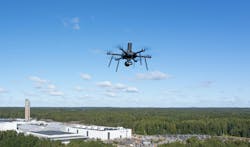
FREMONT, Calif. - Amprius Technologies Inc. in Fremont, Calif., announced that Nokia in Espoo, Finland, has selected Amprius' SiCore cells to power its next-generation uncrewed aerial systems (UAS). After qualification and testing, the batteries met the endurance, power delivery, and safety requirements for Nokia's drone-in-a-box platform.
Amprius' cells provide the burst power needed for takeoff and the sustained energy required for extended flight. The lightweight design and high energy density support payloads such as LiDAR, thermal imaging systems, and 5G communication modules without reducing endurance or reliability.
"Amprius' batteries offer performance gains that meaningfully enhance our drone capability," said Thomas Eder, head of Embedded Wireless Solutions at Nokia. "With SiCore, we can extend mission range, increase payload versatility, and improve system efficiency while maintaining the safety and reliability our customers expect. These advancements strengthen our leadership in public safety and industrial monitoring, and open new opportunities for mission-critical aerial operations."
UAS operations
Nokia says its latest release of Nokia Drone Networks is designed for rapid deployment and large-scale use. The system combines 5G connectivity with an open architecture to support secure, long-range beyond-visual-line-of-sight missions. The platform's Extra Long Range capability, paired with Amprius' cells, increases the operating reach of automated drone fleets.
"Nokia's selection further demonstrates Amprius' leadership in aviation battery technology and reflects the growing demand for our SiCore platform in high-impact deployments," said Dr. Kang Sun, CEO of Amprius Technologies. "As UAVs take on more complex and autonomous missions, energy density and temperature control become decisive advantages. Our technology enables drones to operate longer, carry more, and perform in conditions once considered impractical, helping customers improve safety, minimize downtime, and increase mission value."
Amprius works with partners in UAVs, electric vertical takeoff and landing aircraft, and advanced mobility platforms. The company develops high-energy batteries designed for endurance and durability in field operations.
About the Author
Jamie Whitney
Senior Editor
Jamie Whitney joined the staff of Military & Aerospace Electronics in 2018 and oversees editorial content and produces news and features for Military & Aerospace Electronics, attends industry events, produces Webcasts, and oversees print production of Military & Aerospace Electronics.
Voice Your Opinion!
To join the conversation, and become an exclusive member of Military Aerospace, create an account today!

Leaders relevant to this article: