Boom Supersonic announces Crusoe as launch customer for Superpower turbine for data centers
Key Highlights
Summary Points
- Superpower turbine shares core technology with Boom’s Symphony jet engine for the Overture supersonic airliner.
- Crusoe orders 29 Superpower turbines to power AI data centers.
- Boom plans to ramp turbine production to more than four gigawatts annually by 2030.
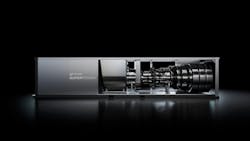
DENVER - Boom Supersonic announced Crusoe Energy - both in Denver - as the launch customer for 29 of its Superpower turbines to act as the power source for its artificial intelligence (AI) data centers. The company also announced it has closed a $300 million funding round led by Darsana Capital Partners, with participation from Altimeter Capital, ARK Invest, Bessemer Venture Partners, Robinhood Ventures, and Y Combinator.
The Superpower natural gas turbine is designed to deliver reliable energy to AI data centers while supporting the development of Boom’s supersonic flight technology. The same supersonic engine core architecture underpins both the Superpower turbine and Boom’s Symphony jet engine, an all-new engine designed for high-power output under challenging thermal conditions.
Boom said Superpower can accelerate AI data center deployment by providing gigawatts of new generating capacity, while also advancing the development and certification of the company’s Overture supersonic airliner by generating engine-reliability data.
Related: Boom works with regulators to define new supersonic commercial air travel rules
"Supersonic technology is an accelerant, of course, for faster flight, but now for artificial intelligence as well," said Blake Scholl, founder and CEO of Boom Supersonic. "With this financing and our first order for Superpower, Boom is funded to deliver both our engine and our airliner."
Unlike conventional power turbines that lose generation capacity in high ambient temperatures, Boom notes the turbine does not require water for operation, which the company said is a significant advantage for AI data centers where water availability can be constrained.
"Boom’s innovative approach to power turbine technology builds on the company’s impressive breakthroughs in supersonic flight," said Chase Lochmiller, co-founder and CEO of Crusoe. "At Crusoe, we are continuously searching for new approaches to increase real-world performance and accelerate time-to-power across our portfolio of energy assets and operations. We are proud to partner with Boom as the launch customer for Superpower, an initiative that aligns with Crusoe’s energy-first approach to building the AI infrastructure of the future."
Related: Boom's XB-1 test plane shows supersonic flight with no audible sonic boom
Boom said total Superpower turbine production is planned to ramp to more than four gigawatts annually by 2030. Using its supersonic design expertise and advanced materials, the company said Superpower delivers improved real-world price performance compared with other aeroderivative engines.
According to Boom, Superpower provides 42 megawatts of ISO-rated power in a shipping-container-scale package, maintains full rated output in ambient temperatures above 110 degrees Fahrenheit, operates without water to enable deployment in hot and arid regions, and runs on natural gas with backup diesel capability.
Boom said Superpower turbines will be built in the United States. The company said 95% of the parts for its Symphony engine core prototype are currently in manufacturing, with testing scheduled to begin in 2026 at Boom’s test facility in Colorado. Boom’s Overture order book totals 130 aircraft, including orders and pre-orders from United Airlines, American Airlines, and Japan Airlines.
About the Author
Jamie Whitney
Editor-in-Chief
Jamie Whitney joined the staff of Military & Aerospace Electronics in 2018 and oversees editorial content and produces news and features for Military & Aerospace Electronics, attends industry events, produces Webcasts, and oversees print production of Military & Aerospace Electronics.
Related
Voice Your Opinion!
To join the conversation, and become an exclusive member of Military Aerospace, create an account today!
 Leaders Logo
Leaders relevant to this article: