Raytheon to build 408 AIM-9X Block II infrared-guided air-to-air missiles for U.S. Navy, Air Force, allies
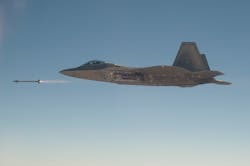
PATUXENT RIVER NAS, Md. – U.S. Navy aerial warfare experts are asking Raytheon Technologies Corp. to build 408 AIM-9X precision short-range infrared-guided air-to-air missiles for jet fighters and other combat aircraft under terms of a $317.4 million contract announced in December.
Officials of the Naval Air Systems Command at Patuxent River Naval Air Station, Md., are asking the Raytheon Missiles & Defense segment in Tucson, Ariz., to build lot 23 AIM-9X block II and block II-plus air-to-air missiles.
These anti-aircraft missiles are for the U.S. Air Force, Army, and foreign allies.
The order is for AIM-9X Block II and II-plus tactical missiles; captive air training missiles; missile containers; spare advanced optical target detectors; spare advanced optical target detector containers; guidance units; propulsion steering sections; guidance unit containers; spare block ii captive air training missile guidance units; tail caps; tail cap containers; tactical sectionalization kits; electrical units; dummy air test missiles; support equipment; general-purpose controllers; and non-recurring engineering.
The AIM-9X is an infrared-guided heat-seeking missile that equips most jet fighters, fighter-bombers, and other offensive combat aircraft in the U.S. arsenal, and is for shooting down enemy aircraft close-by. The AIM-9X works by homing in on an enemy aircraft's hot engine exhaust. Variants of the AIM-9 Sidewinder have been deployed since the 1950s.
The AIM-9X is among the latest versions of the AIM-9 missile family. It entered service in 2003 on the Navy F/A-18C Hornet fighter-bomber and on the U.S. Air Force F-15C jet fighter. It has an imaging infrared focal plane array seeker with 90-degree off-boresight capability for accuracy.
The missile is compatible with helmet-mounted displays such as the U.S. Joint Helmet Mounted Cueing System, and features 3-D thrust-vectoring control for increased turn capability. The AIM-9X also includes an internal cooling system.
This contract involves the latest versions of the AIM-9X, called the AIM-9X Block II and AIM-9X Block II-plus. This newest version has lock-on after launch capability for use with the F-35 Lightning II joint strike fighter and the F-22 Raptor advanced tactical fighter.
The AIM-9X Block II-plus features specialized external materials to enhance aircraft survivability for the F-35. Until another version of the AIM-9X is developed that will fit inside the F-35's enclosed weapons bay, the AIM-9X Block II-plus has stealthy coatings and structures to help reduce the missile's radar cross-section when the F-35 carries these missiles externally.
On this contract Raytheon will do the work in Tucson, Ariz; North Logan, Utah; Linthicum Heights, Md.; Minneapolis; Murrieta, Calif.; Saint Albans, Vt.; Ann Arbor, Mich.; Warrington, Pa., and other U.S. locations, and should be finished by August 2026.
For more information contact Raytheon Missiles & Defense online at www.raytheonmissilesanddefense.com, or Naval Air Systems Command at www.navair.navy.mil.
