Navy taps Boeing and Lockheed Martin for passive infrared sensor for covert aircraft tracking
Key Highlights
Questions and answers:
- What is the IRST Block II system, and what aircraft will use it? IRST Block II is a passive infrared search-and-track sensor for the U.S. Navy’s F/A-18E/F Super Hornet that detects and tracks enemy aircraft by their heat signatures without emitting radar energy.
- How does IRST Block II improve on the earlier Block I version? Compared to Block I, IRST Block II offers greater detection range and sensitivity, improved target tracking and classification, better sensor-data fusion, and enhanced performance against advanced and stealthy threats.
- Who is integrating the IRST Block II systems and under what contract? Boeing is integrating 16 IRST Block II systems under a $25.5 million Navy contract, with the sensor technology supplied by Lockheed Martin Missiles and Fire Control.
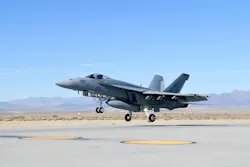
PATUXENT RIVER NAS, Md. – U.S. Navy air combat experts are asking electro-optics engineers at the Boeing Co. and Lockheed Martin Corp. to design and build 16 improved infrared search and track (IRST) sensors for the F/A-18E/F Super Hornet jet fighter-bomber to enable the aircraft to detect, track, and attack enemy aircraft in a stealthy way without making its presence known.
Officials of the Naval Air Systems Command at Patuxent River Naval Air Station, Md., announced a $25.5 million contract in late January to the Boeing Co. Defense, Space & Security segment in St. Louis to design and build 16 IRST Block II systems.
The IRST Block II is a passive infrared sensor that detects, tracks, and targets aircraft by their heat signatures without emitting radar energy. It fits in a modified centerline fuel tank pod on the Super Hornet, and improves detection of stealthy or non-emitting enemy aircraft at long ranges.
Compared to its IRST Block I predecessor, the IRST Block II offers greater detection range and sensitivity; improved aircraft tracking and classification; better fusion with onboard sensors and off-board data; and enhanced performance against advanced threats like stealth aircraft.
Weapons-quality tracking
The system, which Boeing is buying from the Lockheed Martin Missiles and Fire Control segment in Orlando, Fla., uses infrared search and track technology to detect and provide weapon-quality track solutions on potentially hostile aircraft.
The IRST consists of a passive longwave infrared receiver, a processor, inertial measurement unit, and environmental control unit. The infrared receiver, processor, and inertial measurement unit are fitted inside the sensor, which attaches to the front of the fuel tank mounted to the aircraft on the BRU-32 bomb rack.
The Navy developed the original IRST Block I using components from the F-15K/SG aircraft's infrared receiver, which is based on the IRST design of the now-retired Navy F-14 Tomcat jet fighter.
Even amid electronic attack or heavy RF and infrared countermeasures, IRST provides autonomous, tracking data that increases pilot reaction time, and enhances survivability by enabling first-look, first-shoot capability, Lockheed Martin officials say.
No electronic signals
Infrared sensors like the IRST detect the heat from an aircraft's engine exhaust or even the heat generated by the friction of an aircraft as it passes through the atmosphere. Unlike radar, infrared sensors do not emit electronic signals, and do not give away their presence to adversaries.
This ability can enable Super Hornet pilots to identify enemy aircraft at long ranges, and enable them to fire their air-to-air missiles at their maximum ranges.
Data from the IRST system can stand alone or fuse with other on-board sensor data situational awareness. Lockheed Martin also is developing an IRST pod that can be fitted to the F-15C and F-16 jet fighters.
On this contract Boeing and Lockheed Martin will do the work in St. Louis and in Santa Ana, Calif., and should be finished by August 2028. For more information contact Boeing Defense, Space & Security online at www.boeing.com/defense/fighters-and-bombers/fa-18-super-hornet-and-ea-18-growler; Lockheed Martin at www.lockheedmartin.com/en-us/products/irst21-sensor-system.html; or Naval Air Systems Command at Paste link here.
