NASA issues partnership call to continue CYGNSS satellite data collection
Key Highlights
- Partners must secure their own funding; NASA favors self-funded approaches and may provide limited nonreimbursable support.
- The mission's data supports applications in weather forecasting, flood monitoring, soil moisture assessment, and environmental research.
- Multiple organizations or consortia can submit proposals, with opportunities for full or partial partnership arrangements.
- The deadline for proposals is February 26, 2026, and detailed information is available on the official NASA solicitation webpage.
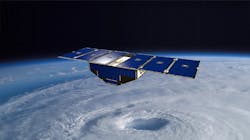
WASHINGTON - The National Aeronautics and Space Administration (NASA) is seeking industry and academic partners to take over operations and data collection for the Cyclone Global Navigation Satellite System (CYGNSS) Earth science mission, as the agency looks to extend the mission of the small-satellite constellation ahead of its projected deorbit in 2027.
The space agency issued an announcement for partnership proposals inviting innovative, non-funded partnerships to support continued CYGNSS mission operations, science data collection, processing, calibration, and distribution. The effort aims to enable broader use of CYGNSS data while advancing the commercial remote sensing industry.
CYGNSS consists of seven microsatellites flying in a 35-degree inclination circular orbit at about 440 kilometers altitude. Each spacecraft uses Global Navigation Satellite System Reflectometry to measure GPS signals reflected from the Earth’s surface. Over oceans, the measurements are sensitive to surface roughness and wind speed, while over land, they can be used to assess soil moisture, inland water bodies, and flooding.
Related: Keeping a watchful eye on Earth observation and weather forecasting
A decade in space
Launched 15 December 2016, CYGNSS is managed by the University of Michigan, with mission operations provided by the Southwest Research Institute. NASA said the spacecraft and its instruments are functioning normally, with no known hardware issues that would limit the mission's lifetime. Current estimates predict the constellation will naturally deorbit between May and August 2027. The satellites carry no propulsion systems or onboard consumables.
NASA said it is open to a wide range of partnership concepts, including full or partial use of existing mission operations teams under reimbursable agreements. The agency may select multiple partners or consortium-based proposals involving several organizations. Areas of interest include mission operations, ground systems, science data processing and archiving, calibration, data latency, and access.
Under the announcement, NASA will not provide funding to partners. Organizations responding to the solicitation must secure their own funding and describe their financial plans and execution capability in their proposals. While proposers may request limited nonreimbursable support from NASA, the agency said evaluation criteria discourage such requests and prioritize self-funded approaches.
CYGNSS was the first NASA Earth science mission based on GNSS Reflectometry and the agency’s first Earth-observing constellation built from small satellites. Its science scope has expanded beyond its original focus on tropical cyclone wind measurements to include applications such as extratropical storms, mesoscale convective systems, soil moisture, flood inundation, wetlands monitoring, and river characteristics.
Questions and responses should be directed to Beth Weinstein of NASA’s Earth Science Division at [email protected]. Proposals are due by 26 February 2026 at 4 p.m. Eastern. More information is available at https://sam.gov/workspace/contract/opp/210060ee5afb4103853d6b74b0d21234/view.
