Army researchers eye AI and machine learning for navigation and guidance in gun-fired smart munitions
Key Highlights
Questions and answers:
- What technologies are the U.S. Army seeking to improve gun-fired smart munitions? Artificial intelligence, machine learning, and other technologies to improve the accuracy and guidance of gun-launched smart munitions.
- What new concept could enable several smart munitions to work together in flight? The Army is exploring collaborative control, in which one “leader” munition communicates targeting data to other munitions in a volley so they can adjust course and strike different targets.
- How might smart munitions navigate if GPS signals are unavailable? Researchers are considering alternatives such as terrain mapping, optical recognition of ground features, and celestial navigation using the sun and stars to maintain accurate positioning.
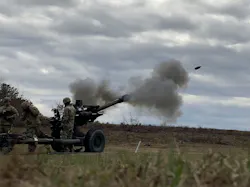
PICATINNY ARSENAL, N.J. – U.S. Army researchers are asking for industry's help to develop artificial intelligence (AI), machine learning, and other enabling technologies to improve the accuracy of gun-fired smart munitions.
Officials of the Armaments Center of the Army Combat Capabilities Development Command (DEVCOM) at Picatinny Arsenal, N.J., issued a broad agency announcement (W15QKN-26-S-1AZR) last week for the DEVCOM AC Emerging Technologies project, which revolves around smart munitions navigation and guidance that can withstand the high G loads of cannon firing.
The Army has a need for long-range precision guidance to enable a gun-launched munition to fly faster, further, and more accurately than ever before in acquiring targets, with the added ability to conduct midcourse corrections with and without GPS satellite navigation.
Essentially, Army experts want to design a munition that not only is smart, but also has the ability to communicate with other munitions in flight -- sometimes in a leader-follower scenario in which several smart munitions fire in a volley.
Collaborative control
The leader munition would communicate with the other munitions and provide them with targeting information so they can make corrections in flight to attack different targets. This involves a new field called collaborative control.
Because of the increase in launch velocities necessary for long ranges, flight times, and maneuverability, Army experts want to define accurate robust navigation and position transmission technologies -- especially if munitions need to communicate with one another. This can include technologies to improve the projectile's onboard state estimation without GPS satellite navigation data.
Terrain mapping could be one way to improve accuracy, so the ability to download maps to the munition, and enabling the munition to follow these maps optically to recognize sites on the ground is of critical importance. Celestial navigation -- or the ability for the munition to locate itself in relation to the sun and stars -- also could play a role in terrain-mapping smart munitions guidance.
Terrain mapping
For this, Army research focuses on terrain mapping, celestial navigation, or other ways to improve gun-fired smart munitions accuracy. Researchers also are interested in general machine intelligence and autonomy for location, mapping, and situational understanding.
Companies interested should email white papers no later than 4 March 2031 to the Army's Kelly Lynch at [email protected]. Those submitting promising white papers may be invited to submit full proposals.
Email administrative questions or concerns to Kelly Lynch at [email protected]. Email technical questions to Jessica Gondela at [email protected]. More information is online at https://sam.gov/workspace/contract/opp/b75c77d156b14c84af07401ed51ec7f3/view.
