Army asks industry for enabling technologies in fire control, electro-optics, and sensor fusion
Key Highlights
Questions and answers:
- What is the U.S. Army seeking from industry in the DEVCOM Emerging Technologies project? Advanced fire-control, including optics and electro-optics, navigation and positioning sensors, fire-control algorithms, system controllers, photonics and quantum technologies, and training systems.
- What kinds of navigation and positioning technologies are of interest to Army researchers? Sensors such as non-magnetic compasses, gyroscopes, inclinometers, and accelerometers, as well as position, navigation, and timing (PNT) technologies designed to operate in anti-jam and anti-spoof environments.
- How can companies participate in the Army’s DEVCOM Emerging Technologies effort? Interested companies must submit white papers to the Army by 4 March 2031, after which those with promising ideas may be invited to submit full proposals.
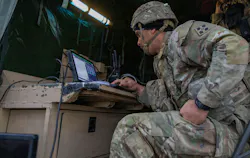
PICATINNY ARSENAL, N.J. – U.S. Army researchers are asking for industry's help in developing fire-control technologies in technical fire control; position and navigation; fire-control algorithms; system controllers; photonics and quantum science technologies; and live, virtual, and embedded fire-control trainers.
Officials of the Armaments Center of the Army Combat Capabilities Development Command (DEVCOM) at Picatinny Arsenal, N.J., issued a broad agency announcement (W15QKN-26-S-1AZR) last week for the DEVCOM AC Emerging Technologies project.
Advanced Technical fire-control involves direct view optics, and electro-optic sighting for military equipment. Areas of interest are optics materials and equipment; electro-optics, fiber-optics, and sighting system technologies; enemy threat capabilities; aircraft and land vehicle signature reduction; infantry target acquisition; improved soldier protection; sensors and effects to deny access to critical points and provide force protection; soldier signature reduction; modeling and simulation to determine survivability; bio-mimicry advances in flexible photodetectors, smart optics, adaptive optics, and advanced weapon sights; micro-electro-mechanical systems (MEMS); improved situational awareness and position sensors; and machine autonomy.
PNT sensors
Army researchers also want new position or navigation sensors like non-magnetic compasses, gyroscopes, inclinometers, and accelerometers. This involves position, navigation, timing (PNT) technologies for anti-spoof and anti-jam environments, and machine intelligence and autonomy for PNT.
Also of interest is situational awareness on enemy attempts to deny and degrade U.S. and allied PNT, such as munitions-hardened payloads to sense the battlefield for PNT denial.
Advanced fire-control algorithms involves rapid sensor-to-shooter target hand-off, including reduced soldier cognitive workload; integrating crewed and uncrewed effects; GPS-denied soldier tracking; lethal uncrewed vehicle integration; and machine autonomy for fire control.
Target acquisition calls for an auto-tracker in small, medium, and large weapon sights, with closed loop fire-control and data links; projectile tracking; correcting for miss distances; target state estimation; auto tracking; aided cueing; aiming aids; ballistic computation; weather measurements and prediction; swarming weapons; and automated target detection.
Small size and weight
Advanced system controllers with small sizes; reduced power consumption; ruggedization; expandable interfaces; standard architectures; self-diagnosing and reporting; and remote displays and user inputs via standard interfaces like Ethernet.
Also of interest are photonics and quantum science technologies for fire control, target acquisition and tracking, signature reduction, and spoofing technology; integrated photonics to reduce size, weight, and power for fire-control and armament systems; power efficient computing in austere environments; photonics and quantum-based technologies for PNT and armament; target acquisition obscured targets; technologies to control laser wave fronts for fire-control; software for low photon target image processing machine learning; and technologies for laser protection.
Live, virtual, and embedded fire-control trainers for fire control involves computer vision and graphics; small size and weight; ; ruggedization technologies; and low-bandwidth secure networking.
Sensor fusion and networking
Advanced fire control involves uncrewed and autonomous systems with advanced fire-control; sensor fusion and networks to increase fire control and diagnostic effectiveness; downrange wind sensors; dynamic fires planning and execution; real-time localized environmental data for fire-control corrections; and machine intelligence and autonomy.
Companies interested should email white papers no later than 4 March 2031 to the Army's Kelly Lynch at [email protected]. Those submitting promising white papers may be invited to submit full proposals.
Email administrative questions or concerns to Kelly Lynch at [email protected]. Email technical questions to Jessica Gondela at [email protected]. More information is online at https://sam.gov/workspace/contract/opp/b75c77d156b14c84af07401ed51ec7f3/view.
