Army picks three to develop affordable image-intensifier night vision for situational awareness
Key Highlights
Questions and answers:
- What is the U.S. Army’s BiNOD program? The Binocular Night Observation Device (BiNOD) program is a $1.27 billion effort to develop next-generation, lightweight binocular night-vision goggles to improve soldiers’ night-fighting capabilities.
- Which companies were awarded BiNOD development contracts? Contracts were awarded to L3Harris Technologies, Elbit Systems of America, and Photonis Defense to develop competing designs.
- How does BiNOD differ from earlier night-vision systems? BiNOD focuses on image-intensification technology for low-light visibility and stereoscopic vision, without using thermal imaging, making it more affordable and suitable for widespread Army use compared to systems like ENVG-B.
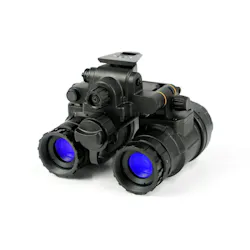
ABERDEEN PROVING GROUND, Md. – U.S. Army night vision experts are spending $1.27 billion to acquire next-generation binocular night-vision goggles to modernize soldier night-fighting equipment.
Officials of the Army Contracting Command at Aberdeen Proving Ground, Md., awarded three contracts in late February to develop and build the Binocular Night Observation Device (BiNOD).
L3Harris Technologies in Londonderry, N.H., won a $466 million BiNOD contract; Elbit Systems of America in Roanoke, Va., won a $450.6 million BiNOD contract; and Photonis Defense Inc. in Lancaster, Pa., won a $352.6 million BiNOD contract.
BiNOD is a next-generation night vision system to provide Army soldiers with a standardized, lightweight, binocular night vision goggle to replace or augment older systems.
Low-light conditions
Formerly called the Night Vision Device–Next (NVD-N), BiNOD focuses on fielding improved night vision goggles based on a helmet-mounted, binocular image-intensification system that enhances vision in low-light conditions. It does not use thermal imaging long-wave infrared sensors.
BiNOD is not one system from one company; it is a competitive multi-contractor program with three vendors that will develop their own designs. Army experts will evaluate and buy systems through task orders to L3Harris, Elbit, and Photonis over time.
The BiNOD project is designed to improve soldier situational awareness, depth perception in true stereoscopic vision, and mobility and speed at night. The project emphasizes low cost per unit for large-scale Army fielding; high-performance image intensification; a lightweight, rugged, and soldier-friendly design; compatibility with modern combat systems and helmets; and long operational life with simplified logistics and sustainment.
Although BiNOD primarily is based on image-intensifier tube technology, it makes limited use of near-infrared illumination as a light source -- essentially an invisible flashlight -- that image-intensifier tubes can detect and amplify. This is useful in total darkness like indoors, in caves, and where there is no moonlight.
Image-intensifier tubes
An image-intensifier tube amplifies light from starlight, moonlight, or infrared illumination by thousands of tens of thousands of times to make dim scenes visible in near-darkness.
BiNOD builds on enabling technologies from earlier programs like the Enhanced Night Vision Goggle–Binocular (ENVG-B), yet represents a move toward more affordable standardized binocular night vision for general Army use.
In contrast, ENVG-B is a high-end combat night vision system with image intensification and thermal imaging, which fuses low-light and thermal imaging into one display. This system is relatively expensive, and offers augmented reality overlays and network connectivity with weapons and other systems.
Special forces night vision
The AN/PVS-31 night-vision system is a lightweight, high-performance binocular night vision goggle for special operations forces. It is lightweight and compact, offers excellent image quality, but has no infrared capability.
On these contracts, L3Harris, Elbit, and Photonis will do the work at locations to be determined with each order, and should be finished by February 2033.
For more information contact L3Harris Technologies online at www.l3harris.com/all-capabilities/night-vision-goggles; Elbit Systems of America at www.elbitamerica.com/night-vision; Photonis Defense at www.photonisdefense.com; or the Army Contracting Command at www.army.mil/acc.
