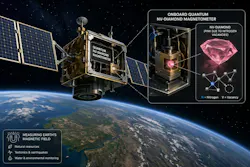
BRNO, Czech Republic - Honeywell Aerospace in Brno, Czech Republic, will lead a European group developing a compact quantum magnetometer for the European Space Agency (ESA), aiming to demonstrate a low-size, weight and power (SWaP) sensor capable of high-performance magnetic field measurements from orbit.
Honeywell Aerospace is partnering with Australia-based Quantum Brilliance and Poland's Jagiellonian University to develop, test and deliver the instrument by 2027. Honeywell's engineering team in Brno, Czech Republic, is leading the project.
The system combines Honeywell's space systems engineering experience with Quantum Brilliance's nitrogen-vacancy (NV) diamond quantum sensing technology and Jagiellonian University's physics research expertise. According to the companies, the resulting instrument is intended to provide full-vector magnetic field measurements while meeting the stringent size, weight, and power (SWaP) requirements of satellite payloads.
Related: Honeywell unveils new aerospace brand ahead of June spin-off
Diamond sensors
Unlike some quantum sensing approaches that require cryogenic cooling or complex vacuum systems, NV-diamond sensors operate at room temperature. The technology uses atomic-scale defects within diamond crystals to detect magnetic fields, enabling compact solid-state sensors suited for space applications where payload mass and power consumption are tightly constrained.
Honeywell said the system is intended to support higher-resolution measurements of Earth's magnetic field while offering improved radiation tolerance and smaller payload footprints for future spacecraft.
"Quantum sensors are a breakthrough technology and their development is gaining traction globally," Jan Lukáš, quantum sensing technical lead at Honeywell Aerospace, said in a statement. "As the race to lead in this technology's development intensifies, this new alliance will help Honeywell Aerospace push the technology forward."
According to Quantum Brilliance, its diamond-based sensor can directly reconstruct three-dimensional magnetic field vectors from a single sensing element, reducing alignment complexity compared with conventional multi-sensor approaches. The company said the technology also offers a wide dynamic measurement range while maintaining stable operation across varying magnetic field conditions.
Related: AFRL awards Booz Allen $25.3 million for quantum technology research project
"Our collaboration with Honeywell Aerospace and Quantum Brilliance is an important step toward demonstrating a low-SWaP quantum sensor," John Liobe, technical director of European quantum sensing programs at Quantum Brilliance, said in a statement. "This project unlocks a pathway to scalable manufacturing for the benefit of future satellite constellations for Earth science and space domain awareness."
ESA quantum interest
ESA has shown growing interest in quantum sensing technologies for space applications in recent years. Agency technology initiatives have explored miniaturized NV-diamond magnetometers designed for spacecraft with stringent SWaP constraints, including concepts intended for small satellites. Those development efforts have focused on improving measurement sensitivity, reducing payload size, and increasing resilience to the space environment.
The Honeywell-led effort represents another step toward transitioning quantum sensing technologies from laboratory research into space-qualified hardware. Although the consortium has not disclosed technical performance specifications or identified a flight mission for the instrument, the project reflects continued investment in compact quantum sensors for future Earth observation and scientific spacecraft.
The group expects to deliver the quantum magnetometer to ESA in 2027.