Navy expands production of GDMS Hammerhead undersea warfare system
Key Highlights
- The contract includes procurement of 188 Hammerhead units and support equipment, with work scheduled to be completed by October 2028.
- Hammerhead is designed to detect, classify, and engage submarine threats using integrated sensors and autonomous weapon effects.
- The system enhances the Navy's distributed maritime capabilities, operating effectively in environments with limited communication options.
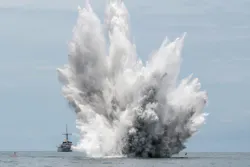
TAUNTON, Mass. - The U.S. Navy is expanding production of General Dynamics Mission Systems' (GDMS) Hammerhead Encapsulated Effector system under a $229.7 million contract modification for additional undersea warfare capabilities.
Naval Sea Systems Command awarded GDMS in Taunton, Mass., a fixed-price incentive modification to previously awarded contract N00024-21-C-6425 for the procurement of 188 additional Hammerhead units and eight complementary peculiar support equipment sets. Work will be performed in Taunton, Braintree, and Wilmington, Mass.; Lincoln, Neb.; and Accident, Md., and is expected to be completed by October 2028.
Hammerhead is a moored anti-submarine warfare (ASW) mine system designed to integrate undersea sensing capabilities with an encapsulated effector to detect, classify, and engage submarine threats.
Hammerhead is an evolution of the Cold War-era CAPTOR mine but with modern sensors, machine autonomy, and communications capabilities. It's officially known as an Encapsulated Effector (EE) system; instead of being a simple explosive mine, it contains a lightweight torpedo inside a sealed container.
Underwater sensing tech
The system is intended to provide the Navy with an advanced undersea warfare capability by combining persistent underwater sensing with a weapon effect in a deployable system. Hammerhead reflects a broader Navy effort to expand distributed maritime capabilities in environments where communications and persistent surveillance can be challenging.
Hammerhead represents a shift toward distributed undersea warfare systems that combine persistent sensing, onboard processing, and an integrated effector. Unlike surface or airborne platforms that can rely on radio-frequency communications and external sensor networks, undersea systems must operate in a communications-limited environment where acoustic sensing, signal processing, power management, and long-duration reliability are critical design considerations.
General Dynamics Mission Systems received the initial Hammerhead design, development, testing, and prototype contract in 2021. The company serves as the prime contractor and systems integrator for the program.
The latest contract modification was not competitively procured because the Navy determined GDMS is the only responsible source capable of meeting current program requirements. The Navy cited the company's existing development efforts and the lack of a complete technical data package needed for competition.
Work under the contract modification will be funded with fiscal 2025 Navy weapons procurement funds.
