GA-ASI demonstrates aircraft passive sensing for CCA teaming
Key Highlights
- The demonstration involved a manned F-5 fighter and uncrewed CCA sharing passive IR sensor data to locate and engage targets.
- GA-ASI's TacACE software enabled autonomous data fusion, coordination, and mission execution between manned and unmanned aircraft.
- Passive IR sensors provide stealthy sensing capabilities, reducing detection risk in contested environments.
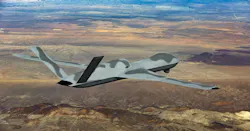
SAN DIEGO - General Atomics Aeronautical Systems Inc. (GA-ASI) and Tactical Air Support Inc. demonstrated how a manned fighter and an uncrewed Collaborative Combat Aircraft (CCA) can share passive infrared sensor information and coordinate an airborne engagement during a large-force exercise earlier this summer.
The flight test paired a Tactical Air Support F-5 Advanced Tiger with a GA-ASI CCA test aircraft to demonstrate Infrared Search and Track (IRST) Multi-Ship Ranging (MSR), building on earlier GA-ASI demonstrations of passive infrared sensing and autonomous target ranging.
Both aircraft were equipped with GA-ASI's TacACE (Tactical Autonomy Ecosystem) software, which is based on the Air Force's Autonomy Government Reference Architecture (A-GRA) and Agile Mission Suite Government Reference Architecture (AMS-GRA). Each aircraft also carried an IRST sensor.
IRST background
Unlike active radar, an IRST sensor does not transmit energy to illuminate a target, making it difficult for an adversary to detect the sensing aircraft based on radar-like emissions. However, a single passive sensor generally provides angular information rather than directly measuring target range.
Multiple sensors distributed across aircraft can provide additional measurements that can be combined to improve target localization and tracking. GA-ASI previously demonstrated single-ship IRST ranging with an MQ-20 Avenger CCA surrogate during a February 2026 Air Force exercise. In that demonstration, TacACE used an IRST sensor to support passive target localization and autonomously estimate target range without active radar emissions.
The July test extended that concept to multi-ship sensing involving a manned F-5 and an uncrewed aircraft.
The aircraft used a beyond-line-of-sight (BLOS) communications link to exchange information during the demonstration. According to GA-ASI, the F-5's AMS-GRA-compatible system provided target information to the CCA's TacACE autonomy system, allowing the two aircraft to coordinate sensing and engagement activities.
For contested-airspace operations, passive distributed sensing could help aircraft build tracks while reducing reliance on active electromagnetic emissions. Combining measurements from multiple aircraft can also improve track quality and target localization while distributing sensing functions across the formation.
USAF open architectures
The Air Force released its AMS-GRA and A-GRA architectures in July 2026 as government-owned reference architectures intended to accelerate integration of mission systems and autonomous capabilities. AMS-GRA establishes a framework for mission-system integration, while A-GRA provides a common baseline for developing, testing, and scaling autonomous capabilities. The architectures are intended to separate mission-system software from safety-critical aircraft functions and make it easier to integrate capabilities from different suppliers.
The Air Force has made interoperability central to its CCA acquisition strategy. The service says continuous A-GRA compliance is required for CCA vendors, allowing autonomy software to be integrated across different aircraft and reducing dependence on a single vendor's proprietary solution.
GA-ASI describes the CCA as semi-autonomous, rather than completely independent. In the July test, the F-5 provided target information to the CCA's autonomy system, while TacACE handled mission-related autonomous functions. The demonstration therefore illustrates a model in which humans provide higher-level direction while autonomous systems perform portions of sensing, data fusion, aircraft coordination, and mission execution.
GA-ASI says the July flight was part of an ongoing campaign of increasingly complex flight tests intended to demonstrate operationally relevant human-machine teaming. The company described the demonstration as showing that a manned fighter and autonomous CCA could find, track, and engage an airborne target using passive sensors and shared autonomy.
For military electronics designers, the demonstration illustrates the convergence of several technologies required for distributed combat aircraft: passive electro-optical sensing, multi-platform sensor fusion, communications, mission computing, autonomous software, and open-system interfaces.
The approach matters because an individual aircraft no longer needs to sense, process, and act on every element of the tactical picture by itself. Instead, a manned fighter and one or more autonomous aircraft can contribute different sensing and processing capabilities to a shared mission.
That distributed architecture could become particularly important in contested electromagnetic environments, where communications links may be degraded, and active sensors may increase the risk of detection. The July demonstration shows one approach to maintaining a cooperative sensing and engagement capability while relying on passive infrared sensors and autonomous mission software.
About the Author
Jamie Whitney
Editor-in-Chief
Jamie Whitney joined the staff of Military & Aerospace Electronics in 2018 and oversees editorial content and produces news and features for Military & Aerospace Electronics, attends industry events, produces Webcasts, and oversees print production of Military & Aerospace Electronics.
Related
Voice Your Opinion!
To join the conversation, and become an exclusive member of Military Aerospace, create an account today!
 Leaders Logo
Leaders relevant to this article: