Flexibility versus low loss performance: How the right cable choices and technology resolve a long-standing compromise
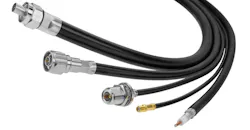
In harsh environments, a common constraint that defense system engineers must increasingly contend with is successfully routing RF interconnects through crowded platforms while maintaining dependable electrical performance. Radios, sensors, electronic warfare modules and control units are often separated by extremely tight spaces and complex cable paths. Bring these systems to an active mission-critical environment, and their interconnects can be exposed to movement, vibration and mechanical stress.
This challenge is laid bare in the design and engineering of coaxial cables and cable assemblies, where conventional inner conductor technology forces a difficult choice. Engineers must choose between solid inner conductors for low loss or stranded conductors for flexibility, with each choice presenting specific pros and cons. Solid conductors offer low loss and stable electrical performance but can be stiff and difficult to install. Stranded conductors improve flexibility, yet the gaps and variations within the strand can contribute to higher attenuation, characteristic impedance discontinuities and reduced stability. Achieving a more useful balance requires a change to the conductor construction.How rotary swaging works
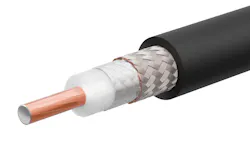
HUBER+SUHNER rotary swaging technology eliminates this compromise by merging the benefits of both solid and stranded wire designs into a single unified solution. Rotary swaging is a process of mechanical deformation and is achieved by repeated blows to a conventional wire strand. The outer surface of the inner conductor is smoothed out like a solid wire, eliminating the occurrence of possible discontinuities. This leads to a solution that not only achieves equivalent insertion loss performances of a solid wire version but also offers even better return loss values on the whole operative frequency range.
The rotary-swaged conductor also better supports phase and amplitude stability during flexure, movement and tensile stress. This is crucial in defense and mission-critical applications, as it helps address a critical requirement: an RF link must not only perform when stationary but continue to provide stable features after routing or during dynamic operative conditions.
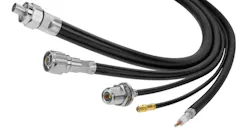
SPUMA RS, SUCOFLEX 118® and 126 – flexibility and low-loss performance in action
SPUMA RS from HUBER+SUHNER are cable assemblies that offers rotary swaged flexibility and low loss in these environments. This family of cables offers attenuation performance comparable with solid-wire cable construction, improved flex behaviour compared with conventional stranded-wire construction and phase stability under flexure. High abrasion resistance, lightweight construction, halogen-free materials and robust shielding further support installation in demanding environments.
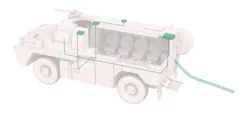
SPUMA RS cables are optimised for low-loss use, up to 6 GHz and are available as bulk cable with ODs of 6.2 mm/10.3 mm/15mm (corresponding respectively to SPUMA_240 / 400 / 600), or pre-assembled solutions with a broad connector portfolio that also includes versions made out of marine steel (SS316L). Their target applications include tactical communications, naval systems and vehicular RF integration, alongside radar, electronic warfare and communications systems on land, air and sea platforms.
SUCOFLEX® 118 and 126 are also MIL-qualified assemblies from HUBER+SUHNER that are used worldwide in all platforms (across land, sea and air). Engineered for precision and durability, they deliver unparalleled performance, with phase and amplitude stability under flexure and exceptional return and insertion loss (identical to the solid-wire versions, respectively 104 and 106), supporting frequencies up to 70 GHz.
Rethinking how cable selection works
System engineers should rethink cable selection, so to not trying to be selecting the least damaging compromise. Proprietary technology like rotary swaging and practical cable assembly examples like the SPUMA RS and SUCOFLEX 118® and 126 from HUBER+SUHNER show that innovation at the design level with conductors can support reliable RF integration in modern defense systems. The flexibility versus loss dilemma can be effectively resolved with the right choices, and without compromising system performance, installation efficiency or long-term reliability.
