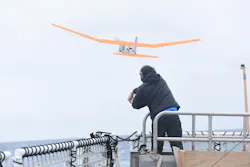
PATUXENT RIVER NAS, Md. – U.S. Navy aviation experts are surveying industry to find companies able to build 20-pound uncrewed aircraft able to provide reconnaissance, surveillance, and target acquisition (RSTA) during the day and at night for the U.S. Marine Corps.
Officials of the Naval Air Systems Command at Patuxent River Naval Air Station, Md., issued a request for information (243-26-024) on Wednesday for the Medium Range Tactical (MRT) Unmanned Aircraft System (UAS) project.
This small uncrewed aerial vehicle (UAV) should be ruggedized; rapidly deployable; and delivered ready for use with minimal logistics, training, and sustainment. It should support mission planning, real-time intelligence collection, tactical situational awareness, and operate independently or as part of a secure, collaborative network.
In addition to reconnaissance and surveillance, the system should support patrolling, security, force protection, convoy, and urban operations. It should be able to operate in austere locations, in diverse climates and weather, and in degraded, denied, intermittent, and limited radio-frequency environments.
Modular sensor payloads
This small UAV should be able to carry modular sensor payloads, provide real-time full-motion video using high-resolution visible-light cameras and infrared (IR) sensors. It also should be able to fly to and from amphibious ships and advanced bases. Vertical-takeoff-and-landing fixed-wing and multirotor configurations are of interest.
The uncrewed aircraft should support autonomous or manual launch and recovery that minimize system damage and enable rapid mission turnaround. One person should be able to carry the ground control station, and the controller should be able to monitor sensor position, display video, and control aircraft movement. It also should be interoperable with existing common control systems.
The system should be designed to work in tactical networks and support secure data sharing with other systems. All mission data and video should store securely on the ground control station and the uncrewed aircraft using removable data storage.
The uncrewed aircraft itself should weight less than 20 pounds, while the total system weight, including ground station, should weigh less than 75 pounds. It should be able to accommodate 3.75-pound payloads with sensors, laser rangefinder, and laser designator.
25-knot speed
It should be able to fly as quickly as 25 knots on missions that last 2.5 hours. It should have a line-of-sight range of 25 miles, use electric or hybrid-electric propulsion, and offer operator-in-the-loop control with semi-autonomous operation.
The uncrewed aircraft should be able to fly without satellite navigation using M-Code GPS, inertial navigation, computer vision, and visual-inertial odometry. One ground control station should be able to operate two or more UAVs.
Companies interested should email unclassified white papers no longer than 30 pages no later than 13 April 2026 to the Navy's Karleigh Hall at [email protected] and Kristen Ferro at [email protected].
Email questions or concerns to Karleigh Hall at [email protected] and Kristen Ferro at [email protected]. More information is online at https://sam.gov/workspace/contract/opp/c86e4748b31f48ec91dedf513a562d73/view.