Army awards Elroy Air $46 million to advance autonomous cargo UAS for contested logistics
Key Highlights
- Elroy Air's Chaparral drone can carry over 500 pounds of cargo up to 450 miles, utilizing hybrid-electric power and modular cargo pods for versatile missions.
- The $46.1 million contract focuses on advancing autonomous navigation, secure communications, and delivery mechanisms suitable for contested environments.
- Demonstrations have shown Chaparral's ability to perform unattended precision airdrops and ground deliveries without personnel or ground infrastructure.
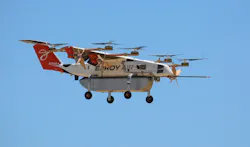
WASHINGTON - The U.S. Army has awarded Elroy Air Inc. a $46.1 million Phase III Small Business Innovation Research contract to develop an autonomous Group IV hybrid vertical take-off and landing (VTOL) uncrewed aircraft system for modular multi-mission payload delivery, with the effort expected to advance technologies for autonomous logistics operations in austere and contested environments.
Army Contracting Command, Aberdeen Proving Ground, Md., awarded the firm-fixed-price contract. Work will be performed in South San Francisco, Calif., with an estimated completion date of 18 Feb. 2029.
Elroy Air said the new agreement builds on Army-funded development conducted during the past two years and will focus on expanding the Chaparral autonomous heavy-cargo aircraft's modular payload capabilities and delivery mechanisms for operations alongside soldiers in contested and austere environments.
Related: Elroy Air completes first autonomous point-to-point cargo delivery with Chaparral drone
The company also identified several enabling technologies it expects to advance under the program, including an expeditionary mobile mission planner, cyber-protected communications links, GPS-denied and contested navigation, increased autonomy, and reliable field operation under military conditions.
Cargo demos
Elroy Air announced in July that it had demonstrated three unattended delivery modes for Chaparral: precision airdrop from a hover, precision airdrop during forward flight, and ground delivery. The company said the delivery modes can be executed without personnel or ground infrastructure at the receiving site.
During a 15 July demonstration at Elroy Air's Byron, Calif., facility, Chaparral released a 68-pound payload from a close-in hover and a 70-pound payload while flying at an altitude of 65 feet. According to the company, software commanded both releases using pre-programmed coordinates, with no operator input during execution. Elroy Air also demonstrated ground delivery in which the aircraft released its payload after landing without personnel at the delivery site.
The July demonstrations show how the Army's earlier airdrop development work is being translated into different delivery options. The new Phase III award appears to encompass a broader technical effort than airdrop alone, based on Elroy Air's description of the program's objectives.
Related: BLADE unveils Dire WOLF logistics UGV for the Army's 'Project Sustainment'
In particular, the planned work on mission planning, navigation, communications and autonomy points to a systems-level challenge: an autonomous cargo aircraft must be able to execute its mission even when the communications and navigation infrastructure normally used to control and monitor aircraft is degraded or denied.
Autonomous operations
Chaparral already incorporates autonomous functions for ground and flight operations. An earlier Army SBIR award described the aircraft as capable of autonomously locating and taxiing to assigned cargo pods using a lidar-based perception system. The system uses ultra-wideband transponders on cargo pods to identify and locate the desired pod, after which the aircraft can position itself over the pod and attach it for flight. The same Army award described the aircraft as capable of carrying 300 to 400 pounds over more than 300 miles with minimal human interaction.
The Army's 2025 airdrop award described Chaparral as a hybrid-electric VTOL Group IV UAS designed for middle-range logistics, with an intended capability at the time of carrying 300 pounds over 300 miles.
Elroy Air's current specifications are higher. The company says Chaparral can carry more than 500 pounds of cargo and has a maximum range of 450 miles. Elroy Air describes the aircraft as using a hybrid-electric powertrain and says it requires no runway, airstrip, or fixed charging infrastructure for operation. These are company specifications rather than performance requirements disclosed in the new Army contract.
The aircraft is designed around modular cargo pods that can be reconfigured for different payloads. Earlier Army SBIR documentation described 27-cubic-foot payload pods capable of carrying supplies, sensors, and fuel, while Elroy Air's current materials emphasize the aircraft's ability to reconfigure for different missions.
The Army has also incorporated Chaparral into broader experimentation. Elroy Air said the company participated in T-REX earlier this year at Camp Atterbury, Ind., an Army installation used for military technology experimentation. The company's history says Chaparral flew at Camp Atterbury as part of T-REX in 2026.
The company is also establishing a domestic production pathway for Chaparral. Elroy Air said it will begin manufacturing the aircraft in the United States later this year through a manufacturing partnership with Kratos Defense & Security Solutions.
About the Author
Jamie Whitney
Editor-in-Chief
Jamie Whitney joined the staff of Military & Aerospace Electronics in 2018 and oversees editorial content and produces news and features for Military & Aerospace Electronics, attends industry events, produces Webcasts, and oversees print production of Military & Aerospace Electronics.
Related
Voice Your Opinion!
To join the conversation, and become an exclusive member of Military Aerospace, create an account today!
 Leaders Logo
Leaders relevant to this article: