DoD's 'Project Agincourt' aims to accelerate autonomous warfare acquisition
Key Highlights
- AUTOWARCOM aims to coordinate autonomous systems across all military domains, including air, land, sea, undersea, and space, to operate effectively in contested environments.
- Project Agincourt focuses on a battlefield-centric acquisition model that brings developers closer to warfighters and reduces the time from concept to operational deployment.
- The initiative emphasizes affordability, scalability, and rapid adaptation of autonomous technologies to meet evolving operational demands and battlefield tactics.
- The planned command will work closely with existing military branches, integrating autonomous systems without displacing current responsibilities, fostering joint-force collaboration.
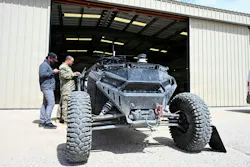
WASHINGTON - Project Agincourt leaders Owen West and Navy Senior Chief Max Strasiser have outlined a roadmap for establishing the Autonomous Warfare Command (AUTOWARCOM), a planned joint combatant command led by a four-star general or admiral intended to accelerate the development, acquisition, and fielding of autonomous and robotic warfare capabilities across the joint force.
In an open letter to the Joint Force and industry partners released 21 Oct., West and Strasiser described a combat-focused acquisition model that pairs technology developers directly with operational military units. The approach aims to move procurement decisions and funding closer to frontline warfighters, measuring success by how quickly an operational problem receives a fielded solution that can be evaluated for broader use.
Defense Secretary Pete Hegseth announced AUTOWARCOM and Project Agincourt on 30 Sept. during his State of the Force address at Marine Corps Base Quantico, Va. Project Agincourt is the interim effort intended to prepare for the new command while developing an acquisition model that connects military operators with commercial technology developers.
Related: Navy demonstrates autonomous mission-planning capability with MQ-20
The Pentagon is targeting 1 Oct. 2027 to establish AUTOWARCOM. The planned command would have service-like authorities to coordinate autonomous warfare across the joint force, but Congress must pass legislation to establish it.
Project Agincourt has two missions: prepare for AUTOWARCOM and continue the Direct Reporting Portfolio Manager for Unmanned Systems (DRPM-UxS) work while pioneering a new acquisition model. West, director of the Defense Innovation Unit, is focused on strategic risk, resources, and scale. Strasiser, a Navy SEAL senior chief, is focused on operational problem-solving and the realities of employing systems in combat.
From acquisition to operational adaptation
The initiative responds to changing warfare economics and operational demands, particularly the proliferation of low-cost drones and the growing use of artificial intelligence in military operations. Hegseth has argued that the lesson from the Russia-Ukraine war is not that one type of drone will win wars, but that the military needs a system capable of adapting rapidly as technologies and battlefield tactics evolve.
In their letter, West and Strasiser compare the current transition to mechanized land warfare with the interwar period. They cite a 1928 initiative by then-Secretary of War Dwight Davis to experiment with a unified mechanized force, including tanks, armored trucks, and motorized infantry. The authors say the effort was later disbanded, with mechanized capabilities absorbed into existing military branches. They argue that the United States should avoid repeating that institutional fragmentation as autonomous systems reshape warfare.
Project Agincourt aims to connect military operators, engineers, and commercial technology developers in faster development, testing, and modification cycles. Hegseth has described the model as "warfighting acquisition," in which decisions and funding move closer to operational units rather than remaining concentrated in Pentagon acquisition offices.
Competitions, exercises, and combat performance will help determine which systems advance toward broader fielding and which are discontinued, according to the letter. One measure of success will be the time required to deliver a fielded solution to an operational problem and evaluate its potential for scale.
Cost is another central consideration. West and Strasiser say the initiative will assess spending against its effect on cost per kill and risk to friendly forces. The objective is to make autonomous capabilities affordable and adaptable at scale, rather than concentrate investment in a particular platform or technology.
The model also calls for flexibility across geographic theaters. For example, a mix of autonomous capabilities suitable for the Indo-Pacific may not meet the requirements of European operations. Project Agincourt aims to let operational commanders develop mission-suited solutions while maintaining a joint-force approach.
The initiative builds on the Pentagon's Drone Dominance program, which Hegseth has described as an effort to accelerate the acquisition and fielding of low-cost unmanned systems. At an Association of the United States Army (AUSA) meeting on 14 Oct., he said the program had received $1 billion in funding for operational users.
A broad autonomous-systems mission
AUTOWARCOM is intended to coordinate autonomous and robotic capabilities across the joint force rather than focus exclusively on aerial drones. The broader vision includes systems operating across air, land, sea, undersea, and space domains, along with the software, sensors, and communications needed to employ them.
At the 14 Oct. AUSA meeting, Hegseth described the future command as a means of integrating autonomous capabilities across domains so they can work together in contested environments. Service leaders also discussed their own efforts to expand the use of autonomous systems.
Acting Secretary of the Army Adam Telle discussed the Army's new Futures and Autonomous Systems Command, intended to consolidate the service's autonomy work and coordinate efforts with other military branches. Acting Secretary of the Navy Hung Cao described the Navy's expanding use of uncrewed surface and underwater systems. Secretary of the Air Force Troy Meink emphasized affordability, scalability, and integrating autonomous aircraft into experimental operations.
Related: GA-ASI demonstrates aircraft passive sensing for CCA teaming
These efforts illustrate the organizational challenge facing AUTOWARCOM: coordinating capabilities developed and operated by separate services without displacing their existing responsibilities. The precise division of authority between the planned joint command, the military services and geographic combatant commands remains to be detailed.
For electronics developers and defense contractors, the initiative's broad scope could encompass embedded computing, edge artificial intelligence, sensors, resilient communications, navigation, power electronics and electronic-warfare-resistant systems. These technologies can help autonomous platforms operate in contested environments and exchange information with other systems. Project Agincourt has not yet published a definitive technical architecture, interface standards or a comprehensive list of acquisition priorities.
A new command remains to be established
The Pentagon's target date for establishing AUTOWARCOM is 1 Oct. 2027. Hegseth said the department will work with Congress to pass the legislation needed to create the command. Its final authorities, leadership and funding arrangements remain important implementation questions.
Project Agincourt's immediate task is to demonstrate that its proposed acquisition model can produce operational results without replacing existing bureaucratic processes with another layer of administration. West and Strasiser write that the initiative must remove barriers that constrain service members' initiative by bringing operations and development closer together.
The letter's central premise is that the military's advantage will depend not only on developing advanced autonomous technologies but also on its ability to adapt them faster than adversaries. AUTOWARCOM is intended to institutionalize that approach, making operational adaptation a continuing function of the joint force rather than an isolated technology program.
About the Author
Jamie Whitney
Editor-in-Chief
Jamie Whitney joined the staff of Military & Aerospace Electronics in 2018 and oversees editorial content and produces news and features for Military & Aerospace Electronics, attends industry events, produces Webcasts, and oversees print production of Military & Aerospace Electronics.
Related
Voice Your Opinion!
To join the conversation, and become an exclusive member of Military Aerospace, create an account today!
 Leaders Logo
Leaders relevant to this article: