Attribable UAS: The global data security blind spot
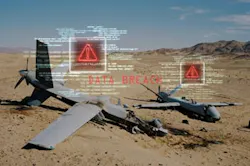
DAVIDSON, N.C. - In multinational operations from the Indo-Pacific to Eastern Europe, attritable uncrewed aircraft have become indispensable for ISR, targeting, and distributed missions. Their rapid proliferation is changing the face of airpower worldwide, but also exposing new risks that cross borders and alliances.
Around the world, armed forces are accelerating investment in attritable uncrewed aircraft: low-cost, high-performance platforms designed for missions where loss is acceptable. These aircraft are reshaping airpower concepts from Europe to the Indo-Pacific, enabling nations to field larger unmanned fleets without the cost burden of traditional systems. At recent multinational exercises, attritable UAS have enabled real-time coalition ISR and targeting, but also raised urgent questions about data protection and interoperability.
But as attritable UAS proliferate, a critical vulnerability is emerging: the mission data stored onboard is often far more valuable than the aircraft itself.
Related: DoD's 'Project Agincourt' aims to accelerate autonomous warfare acquisition
Attritable UAS increasingly support ISR, targeting, maritime surveillance, border security, and autonomous teaming missions. These roles generate sensitive data that, if recovered by an adversary, can jeopardize coalition intelligence, reveal operational patterns, sensor capabilities, or expose allied tactics, techniques, and procedures (TTPs).
Yet many international UAS programs still rely on commercial-grade or unencrypted storage, largely because secure military-grade solutions have historically been too large or too power-hungry for small unmanned platforms. This creates a dangerous gap—not only for national security, but for coalition interoperability.
Why mission data is a global vulnerability
Whether operating in Eastern Europe, the Middle East, Africa, or the Indo‑Pacific, attritable UAS face similar risks:
- High likelihood of loss in contested airspace
- Increased exposure during maritime or border operations
- Potential recovery by non‑state actors
- Coalition operations where data must remain protected across partners
In all these scenarios, the aircraft may be expendable, but the data is not.
A lifecycle challenge for international UAS programs
Across global defense markets, attritable UAS programs face three common lifecycle risks:
1. Early prototypes often fly without secure storage. This exposes telemetry, sensor data, and autonomy logs during testing.
2. Retrofitting secure storage is costly and delays fielding. Small UAS have limited SWaP margins, making late‑stage integration difficult.
3. End‑of‑life disposal differs greatly among nations. Without encryption, data can persist long after the aircraft is retired or transferred.
CSfC and international secure storage standards
While CSfC is a U.S. standard, its multi-layered encryption principles and technologies are increasingly mirrored or adopted by NATO, Five Eyes, and allied nations. This convergence is driving a common approach to secure storage for coalition operations.
The NSA’s Commercial Solutions for Classified (CSfC) program has become a global benchmark for protecting sensitive mission data. While not all nations require CSfC compliance, many view it as a trusted reference architecture for secure data at rest.
A key benefit for international operators: CSfC-compliant storage is ITAR-free. This eliminates export restrictions that commonly hinder coalition acquisition, platform transfer, and fielding. ITAR-free secure storage simplifies joint development, permits rapid technology transfer between trusted partners, and ensures sensitive data can be protected and shared across multinational ISR and targeting missions.
Until recently, CSfC‑aligned solutions were too large for small UAS. But new SWaP‑optimized secure NAS devices now deliver dual‑layer encryption in form factors suitable for Group 2 and Group 3 platforms.
This enables international UAS programs to adopt military‑grade data protection without compromising payload capacity or endurance.
A new era of secure attritable UAS
For allied defense leaders and policymakers, the message is clear: as attritable UAS become central to global defense strategies, interoperable, ITAR-free secure storage must be treated as a baseline mission requirement, not an optional feature. Nations adopting these systems should:
- Integrate secure storage early in development
- Use validated, multi‑layer encryption solutions
- Ensure SWaP‑optimized designs fit small UAS
- Protect data across coalition and joint operations
- Maintain secure chain‑of‑custody workflows
Attritable UAS offer nations a powerful new capability. But only those who prioritize secure, interoperable, ITAR-free storage from the start will preserve operational and coalition advantage, no matter whose flag the platform flies under.
About the author: Steven Petric, Senior Product Manager
The Product Manager for Curtiss-Wright's data storage solutions, Steven is a data-driven professional with over 20 years of experience bringing new offerings to market and improving existing offerings. He holds a Master's in Business, Pragmatic Marketing Certification, and is a Project Management Professional (PMP).