Honeywell integrates SAMURAI C-UAS system on Odys Laila UAV
Key Highlights
- The Laila-SAMURAI system offers a persistent airborne defense layer, extending coverage over large and remote areas like energy platforms and pipelines.
- Laila's hybrid-electric design provides up to eight hours of flight time and a range of approximately 450 miles, supporting long-range missions without fixed infrastructure.
- SAMURAI's modular, open-systems approach allows integration of various sensors and effectors, enhancing adaptability and future scalability.
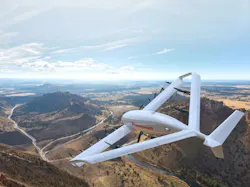
PHOENIX - Honeywell in Phoenix is collaborating with Odys Aviation in Long Beach, Calif., on deploying its persistent airborne defense solution designed to protect assets from evolving drone threats. The effort focuses on integrating Honeywell Aerospace’s Stationary and Mobile UAS Reveal and Intercept (SAMURAI) autonomous airborne platform with Odys Aviation’s long-range Laila uncrewed aerial vehicle (UAV). The companies said the counter-uncrewed aerial system (C-UAS) builds on more than a year of joint development and systems integration work.
The combined Laila-SAMURAI system is intended to provide a defensive layer between ground-based sensors and high-end missile defense systems, reducing reliance on costly kinetic interceptors while extending coverage over large and remote areas. The capability is aimed at protecting distributed infrastructure such as refineries, pipelines, and offshore energy platforms.
"SAMURAI delivers critical counter-UAS capabilities with proven reliability, scalability and seamless integration into existing defense architectures," said Matt Milas, president of Defense and Space at Honeywell Aerospace. "By leveraging Honeywell’s long history in avionics, sensors and defense systems, we are enabling C-UAS capabilities that protect farther, respond faster and operate with minimal downtime."
"Drone threats have fundamentally changed the economics and operational requirements of air defense," said James Dorris, CEO of Odys Aviation. "Critical infrastructure and forward-operating locations require persistent protection across large areas and the ability to engage threats at the horizon long before they're at the doorstep. By combining Honeywell’s SAMURAI system with the endurance, runway independence, and onboard power capability of Laila, we're introducing a new airborne defense layer designed for today and into the future."
Related: NASA seeks industry input on C-UAS detection and analysis services
Laila platform
Laila is a hybrid-electric vertical take-off and landing UAS designed for long-range, runway-independent operations. The aircraft combines a turbine-based generator with electric propulsion to deliver extended endurance and high onboard power availability for mission systems. It can fly missions of about eight hours with a range of roughly 450 miles, while carrying payloads of about 130 pounds.
The platform has a maximum takeoff weight of about 300 kilograms and is designed to operate without fixed infrastructure, enabling deployment in expeditionary and offshore environments. Its hybrid propulsion system, compatible with Jet A, Jet A-1, and JP-8 fuels, can generate approximately 100 kilowatts of electrical power to support onboard sensors, communications, and counter-UAS payloads.
Laila’s architecture also incorporates vertical takeoff capability using thrust-vectoring aerodynamics rather than traditional tilt rotors, allowing operation in confined areas while maintaining efficient forward flight for long-range missions.
Built using model-based systems engineering, SAMURAI is a modular system designed to integrate a range of sensors and effectors. The platform follows Modular Open Systems Approach (MOSA) principles to support interoperability and long-term sustainment. Honeywell said the system incorporates technologies from multiple defense suppliers, including BlueHalo in Arlington, Va.; Leonardo DRS in Arlington, Va.; Pierce Aerospace in Fishers, Ind.; Silent Sentinel in Ware, U.K.; Walaris in Atlanta; Rocky Research in Boulder City, Nev.; and Versatol in McDonough, Ga.
About the Author
Jamie Whitney
Editor-in-Chief
Jamie Whitney joined the staff of Military & Aerospace Electronics in 2018 and oversees editorial content and produces news and features for Military & Aerospace Electronics, attends industry events, produces Webcasts, and oversees print production of Military & Aerospace Electronics.
Related
Voice Your Opinion!
To join the conversation, and become an exclusive member of Military Aerospace, create an account today!
 Leaders Logo
Leaders relevant to this article: