How do aircraft black boxes survive a crash?
Key Highlights
- Black boxes include flight data recorders and cockpit voice recorders, which record hundreds of parameters and cockpit sounds respectively to aid accident analysis.
- These devices are built with crash-resistant enclosures using strong metals and thermal insulation to protect stored data during extreme conditions.
- Flight recorders undergo rigorous impact, fire, water, and crushing tests to meet strict crash-survivability standards before installation.
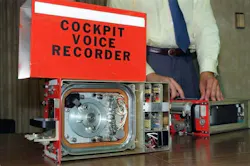
NEWTON, N.H. — When an aircraft crashes, investigators need to understand what happened in the moments leading up to the accident. They often turn to two devices that record information throughout a flight: the flight data recorder and the cockpit voice recorder.
Commonly called black boxes, these devices preserve information about an aircraft's systems and the activity inside the cockpit. Despite their name, most are painted bright orange to make them easier to locate after an accident. Aircraft recorders must withstand conditions that would destroy ordinary electronics, including severe impacts, intense heat and prolonged exposure to water.
What information do black boxes record?
Aircraft typically use two types of crash-protected recorders, although some systems combine both functions into one unit. The flight data recorder (FDR) collects information from aircraft sensors and onboard systems. Depending on the aircraft, it can record hundreds or thousands of parameters, including airspeed, altitude, engine performance and control surface positions.
These measurements help investigators reconstruct how the aircraft behaved before an accident. For example, recorded changes in airspeed and flight control inputs can establish the sequence of events during a flight. The cockpit voice recorder (CVR) captures audio from the flight deck. This includes conversations between pilots and general radio communications.
Investigators examine both recordings together to understand how the aircraft responded to changing conditions and what the crew knew at the time.
How are flight recorders built to survive an impact?
The most important part of a black box is its crash-protected memory, which stores the recorded information. Modern flight recorders generally use solid-state memory rather than older storage systems with moving parts.
Engineers place the memory inside a crash-survivable enclosure designed to absorb and resist extreme forces. The enclosure typically uses strong metals, such as titanium or stainless steel. Engineers also use thermal insulation to slow heat transfer into the enclosure during a fire, helping protect the stored information from extreme temperatures.
The surrounding electronics and outer housing may suffer extensive damage during a crash. However, the recorder's design prioritizes keeping the memory intact, even when other components no longer function.
Aircraft manufacturers also generally install flight recorders toward the rear of the aircraft, where they may have a better chance of surviving certain types of accidents. Their exact placement depends on the aircraft's design, though.
What tests must aircraft black boxes pass?
Flight recorders must meet strict crash-survivability requirements before manufacturers can install them in aircraft. One important standard is EUROCAE ED-112A, which establishes minimum operational performance specifications for crash-protected airborne recorder systems.
Impact testing subjects the recorder to extreme deceleration to simulate the forces generated during a crash. Other tests evaluate its resistance to crushing loads and penetration by objects that could strike the equipment. Manufacturers also test recorders against fire, deep-water pressure and exposure to liquids such as aviation fuel.
These tests focus on data survival rather than whether the recorder remains physically undamaged. A recorder can have a severely damaged exterior and still pass if investigators can retrieve the required information.
How do investigators find black boxes underwater?
When an aircraft crashes into the ocean, locating its recorders can be one of the most difficult parts of an investigation. Many crash-protected flight recorders carry an underwater locator beacon, sometimes called a pinger.
When water activates the beacon, it begins transmitting acoustic pulses that specialized underwater listening equipment can detect. Search teams use hydrophones and other acoustic sensors to listen for those signals. By collecting measurements from different positions, they can narrow down the recorder's location.
The beacon operates on a battery with a limited service life, so search teams must account for how long it can continue transmitting. Water depth, underwater terrain, background noise and the size of the search area can all complicate recovery.
How do investigators recover the recorded data?
After finding a flight recorder, investigators examine it for physical damage and determine whether they can safely access the stored information. If the recorder remains intact, technicians may connect it to specialized equipment to download its data.
When the outer housing or electronic components are badly damaged, specialists can remove the protected memory module and use laboratory equipment to recover the recordings.
Flight data recorder information must then be decoded and interpreted. Investigators compare recorded measurements with aircraft specifications, maintenance records, radar information and other evidence. Cockpit voice recordings require a different type of analysis. Investigators listen for crew communications and cockpit warnings that may establish what occurred.
The two sources often complement each other. Flight data can show what an aircraft did, while cockpit audio can provide context about the crew's actions and the conditions they encountered.
Can black boxes ever be destroyed?
Black boxes are designed to survive severe accidents, but they are not indestructible. A crash can expose recorders to conditions beyond their tested limits. Investigators may also struggle to recover a recorder if it becomes buried in wreckage or lands in difficult terrain.
Even when the protective enclosure survives, damage to connections or electronic components can make retrieving the stored information more complicated. That is why investigators rarely rely on flight recorders alone. They look at air traffic control communications, maintenance records and other available evidence.
About the Author
Samantha McGrail
Associate Editor
Related
Voice Your Opinion!
To join the conversation, and become an exclusive member of Military Aerospace, create an account today!
 Leaders Logo
Leaders relevant to this article: