Leidos earns European certification for B220-HT explosive trace detector
Questions and Answers:
What is the significance of the G1 Standard certification for the B220-HT system? The certification confirms that the Leidos B220-HT meets the latest European Civil Aviation Conference detection requirements, which will become mandatory for all explosive trace detection systems at European Union airport checkpoints in late 2026.
How many B220-HT units are currently in use at European airports? More than 750 units are deployed across European airports, allowing existing customers to remain compliant without operational disruption.
What types of substances can the systems detect? They detect a broad range of military, commercial, and homemade explosives, along with drugs such as cocaine, heroin, MDMA, methamphetamine, and others. Additional substances can be added through the user-expandable detection library.
RESTON, Va. - Leidos in Reston, Va., announced that its B220-HT explosive trace detection system has achieved G1 Standard certification ahead of the European Civil Aviation Conference's latest regulatory mandate for all explosive trace detection systems used across the European Union.
Beginning in late 2026, all explosive trace detection systems used at European Union airport passenger screening checkpoints must meet the stricter detection requirements outlined in the G1 Standard. With more than 750 B220-HT units in use at European airports, the certification supports continued compliance and positions Leidos to assist existing customers without disruption.
System specs
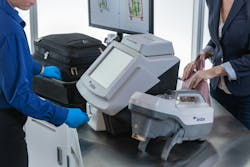
The B220-HT is a desktop system that uses advanced analytical technology to rapidly and simultaneously detect a broad range of explosives and narcotics from trace samples collected from objects or skin. The system is designed for high-throughput airport environments. It is part of Leidos' broader family of trace detection systems, including the TSA-certified QS-B220, which is deployed across U.S. airports.
The QS-B220 uses ion mobility spectrometry analysis technology in a design intended to streamline operation and reduce maintenance requirements. The system simultaneously detects a wide variety of explosives and drugs and provides results within seconds. Results are displayed on the integrated high-resolution touch screen and can be printed on the built-in thermal printer or on an optional external printer.
The QS-B220 features a large touch screen with more than 40 percent more viewing area than other explosive trace detection systems. All functions are accessed through dynamic touch buttons that present only the options necessary for screening. Authorized users can access spectrogram analysis, administrative tools, and diagnostic functions.
It uses inCal automatic calibration and intuitive touch-screen controls. It incorporates a non-radioactive ion source. Maintenance is performed through push-button functions. The system operates with low false alarm rates and supports remote diagnostics. It is designed for low total cost of ownership and holds global certifications, including EU Standard, TSA Checkpoint, and ACSTL.
Detected substances include military, commercial, and homemade explosives such as ammonium nitrate, ANFO, black powder, C-4, detasheet, detonating cord, dinitrotoluene, DMNB, dynamite, EGDN, HMTD, HMX, nitroglycerin, o-MNT, peroxides, PETN, RDX, Semtex, smokeless powder, tetryl, triacetone triperoxide, trinitrotoluene, urea nitrate, and others. Drugs detected include cocaine, heroin, ketamine, L-amphetamine, LSD, MDA, MDMA, methamphetamine, morphine, PCP, THC, and others. Additional substances can be added through the user-expandable detection library.
About the Author
Jamie Whitney
Editor-in-Chief
Jamie Whitney joined the staff of Military & Aerospace Electronics in 2018 and oversees editorial content and produces news and features for Military & Aerospace Electronics, attends industry events, produces Webcasts, and oversees print production of Military & Aerospace Electronics.
Related
Voice Your Opinion!
To join the conversation, and become an exclusive member of Military Aerospace, create an account today!
 Leaders Logo
Leaders relevant to this article: