Viasat taps Rocket Lab for protected GEO SATCOM satellite
Key Highlights
- Viasat's PTS-G program aims to provide worldwide, resilient satellite communications for tactical military users.
- Rocket Lab will supply the Lightning-GEO spacecraft bus, incorporating commercial technology for rapid deployment and cost efficiency.
- PTS-G supports both protected tactical waveforms and anti-jam capabilities to operate in contested environments.
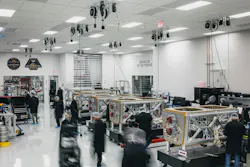
CARLSBAD, Calif. - Viasat Inc. has selected Rocket Lab Corp. to provide the satellite bus for a small geosynchronous Earth orbit (GEO) spacecraft being developed for the U.S. Space Force's Protected Tactical SATCOM-Global (PTS-G) program, combining a commercially derived spacecraft platform with Viasat's protected communications payload.
Viasat announced that Rocket Lab will provide a GEO configuration of its Lightning spacecraft platform for Viasat's PTS-G satellite. The spacecraft will host Viasat's dual-band X- and Ka-band communications payload. Viasat was awarded a prime contract in May to produce one of the first PTS-G satellites, including manufacturing, integration and testing, launch, and on-orbit checkout.
The Viasat spacecraft is part of PTS-G's first production phase, known as Swarm 1. Space Systems Command awarded two contracts totaling $437.7 million to Viasat and Intelsat General Communications in May to produce the first two operational PTS-G satellites. The awards resulted from a competitive Fair Opportunity acquisition that received five offers.
Related: Space Force awards $437.6 million for first Protected Tactical SATCOM-Global satellites
Resilient communications
PTS-G is intended to provide worldwide, resilient satellite communications for tactical users operating in contested and denied environments. SSC says the system will operate in GEO and use dedicated military Ka-band and X-band payloads. The system will also support both Protected Tactical Waveform (PTW) and non-PTW waveforms, providing compatibility with existing wideband users while introducing PTW-based anti-jam communications capability.
Rocket Lab's Lightning-GEO platform will provide the spacecraft bus. According to the company, the platform incorporates vertically integrated spacecraft components and subsystems including tracking, telemetry and command radios, solar power, star trackers, reaction wheels, and flight and ground software. Rocket Lab describes the GEO configuration as a high-power architecture.
The selection reflects the commercial-technology approach underlying PTS-G. SSC established the program in 2025 around commercial baseline spacecraft designs, awarding an initial PTS-G indefinite-delivery/indefinite-quantity contract to five companies to mature designs and demonstrate them against military requirements. SSC said the approach was intended to accelerate delivery, increase competition, and use commercially available products while developing protected tactical SATCOM capability.
SSC has described PTS-G as a component of its broader resilient SATCOM architecture. The command said the first production satellites were expected to launch in 2028, with a second wave of production awards planned for 2028 and additional satellites targeted for launch in 2031.
The Rocket Lab selection adds a spacecraft-bus supplier to Viasat's PTS-G production effort while illustrating the program's use of commercial spacecraft technology for protected military SATCOM. Technical details regarding the satellite's propulsion, maneuverability, payload power, spacecraft size, and the implementation of its anti-jam capability have not been disclosed.
About the Author
Jamie Whitney
Editor-in-Chief
Jamie Whitney joined the staff of Military & Aerospace Electronics in 2018 and oversees editorial content and produces news and features for Military & Aerospace Electronics, attends industry events, produces Webcasts, and oversees print production of Military & Aerospace Electronics.
Related
Voice Your Opinion!
To join the conversation, and become an exclusive member of Military Aerospace, create an account today!
 Leaders Logo
Leaders relevant to this article: