What is a software-defined radio, and how does it work?
Key Highlights
- SDRs perform many signal processing functions via software, allowing for easy reconfiguration without hardware redesigns.
- They support multiple communication standards and frequencies, making them ideal for military, research, and electronic warfare uses.
- Key hardware components include RF front ends, ADCs, DACs, and versatile processors such as FPGAs, DSPs, and CPUs.
- SDRs enable rapid updates and testing of new modulation techniques, protocols, and security features, enhancing operational flexibility.
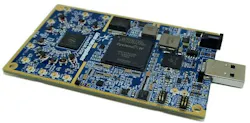
NASHUA, N.H. — Radios transmit and receive information using electromagnetic waves. In a conventional radio, much of the equipment that processes those signals relies on dedicated electronic circuits. A software-defined radio (SDR) performs many of those functions through software running on programmable processors.
This approach allows engineers to change how a radio operates without redesigning all of its hardware. A single SDR platform can support different frequencies, waveforms and communication standards, depending on the capabilities of its components and the software installed.
Related: VIAVI adds TETRA radio testing capability to CX300 communications monitor
What makes a radio software-defined?
Every radio needs hardware to transmit or receive electromagnetic signals. Radio-frequency (RF) components handle the physical signals traveling through the air. The main difference is how the radio processes those signals.
Traditional radios often use dedicated circuits to encode information into radio signals, extract information from received signals and filter out unwanted frequencies. These circuits may be designed around a particular frequency range or communication standard. An SDR moves many of those functions into software. Digital processors perform mathematical operations on signal data, allowing engineers to modify the radio's behavior by changing its programming.
For example, an SDR may be configured to receive one type of digital communication signal and later be reprogrammed to process another. The hardware must still support the required frequencies and signal characteristics. The antenna, RF front end, converters and processing components determine what the radio can physically transmit and receive.
How does a software-defined radio receive signals?
Receiving a radio signal begins when electromagnetic waves reach an antenna, which converts that energy into an electrical signal. That signal enters the radio's RF front end, where filters help reject unwanted frequencies and amplifiers increase the strength of signals that may be too weak for further processing.
Depending on the radio's architecture, the receiver may also shift the signal to a lower frequency before converting it into digital data. An analog-to-digital converter (ADC) samples the electrical signal and produces a sequence of numerical values. Those samples represent the incoming waveform and allow digital processors to work with it.
The sampling rate and resolution of the ADC affect the signals the receiver can capture and the accuracy with which it represents them. The RF hardware and converter must also accommodate the bandwidth and signal levels involved.
Digital filters isolate portions of the received spectrum. Demodulation algorithms extract information carried by the waveform. Other processing stages help the receiver stay synchronized with the signal and decode the transmitted information.
The exact sequence depends on the communication system. A receiver handling a digital data link uses different processing methods from one receiving an analog voice transmission.
How does a software-defined radio transmit?
Transmission follows a similar process, but in reverse. The radio begins with information that needs to be sent, such as voice, data or a control message. Software processes that information and generates digital samples representing the waveform to be transmitted.
Modulation determines how information is represented in the radio signal. Different modulation methods vary characteristics such as amplitude, frequency or phase. A digital-to-analog converter (DAC) turns the waveform samples into an electrical signal. The transmit chain then filters, amplifies and, when necessary, shifts the signal to the desired RF frequency.
Finally, the antenna radiates the signal.
What hardware does an SDR use?
Although software handles many signal-processing tasks, an SDR still depends on specialized electronic components. The RF front end determines which signals the radio can receive or transmit. Filters, amplifiers, mixers and frequency-generation circuits prepare signals for conversion between analog and digital forms.
ADCs and DACs connect the analog RF circuitry with the digital processing system. Several types of processors can perform the digital operations. General-purpose processors offer flexibility and can run complex software applications, while digital signal processors (DSPs) are designed to perform mathematical operations commonly used in signal processing.
Field-programmable gate arrays (FPGAs) can execute many processing operations in parallel. They are useful for tasks that require high throughput or predictable timing, such as filtering and processing wideband signals.
Some SDR systems combine CPUs, DSPs and FPGAs, assigning different functions to the components best suited to handle them. The choice of processing hardware affects power consumption, latency, bandwidth and the complexity of the waveforms the radio can support.
How are software-defined radios used in military communications?
Military aircraft, ground vehicles and ships may use different frequency bands and communication standards. SDR technology allows equipment manufacturers to support multiple compatible waveforms on a programmable radio platform.
Software updates can also introduce supported features, address vulnerabilities or modify signal-processing functions without requiring a complete hardware replacement.
Supporting multiple waveforms can help military forces communicate across different services or with allied nations. However, interoperability still depends on compatible waveforms, security requirements, network configurations and other technical standards.
Software-defined radios also support research and development. Engineers can test new modulation techniques, evaluate communication protocols and modify signal-processing algorithms using programmable equipment.
In some systems, SDR technology provides a foundation for cognitive radio functions. These systems can use information about their operating environment to help select frequencies, waveforms or other communication parameters.
Such capabilities require additional sensing, decision-making and control functions. An SDR does not automatically become a cognitive radio simply because its signal processing is programmable.
What role do SDRs play in electronic warfare?
Electronic warfare systems operate in environments where numerous signals may be present at the same time. Engineers use receivers and signal-processing equipment to detect and analyze emissions across different portions of the electromagnetic spectrum. They can update an SDR's signal-processing algorithms to handle different signals and mission requirements.
Wideband receivers can capture portions of the spectrum for analysis. Digital processing can then help isolate signals, estimate their characteristics and support identification or classification.
Programmable transmitters can also generate waveforms for authorized electronic warfare applications, testing and training. The effectiveness of these systems depends on receiver bandwidth, sensitivity, dynamic range, processing performance and other hardware characteristics.
What are the limitations of software-defined radios?
Digital processing requires computing resources, and complex waveforms or wideband signals can generate large volumes of data. The processors must handle that information quickly enough to meet the system's timing requirements.
Power consumption and heat can also become concerns, particularly in portable military radios and equipment installed on uncrewed platforms.
The RF hardware presents additional constraints. A radio cannot operate at frequencies its components do not support, and software cannot compensate for every limitation in receiver sensitivity, transmitter output power or converter performance.
Software security is another consideration. Programmable radios require careful management of firmware, updates, access controls and waveform implementations, especially when they handle sensitive communications.
About the Author
Samantha McGrail
Associate Editor
Related
Voice Your Opinion!
To join the conversation, and become an exclusive member of Military Aerospace, create an account today!
 Leaders Logo
Leaders relevant to this article: