Rune, Havoc integrate logistics software with autonomous aircraft
Key Highlights
- Rune's TyrOS software uses AI for logistics management, decision support, and operates effectively even with limited communications.
- Havoc's autonomous aircraft are integrated via the ADK, allowing them to be scheduled and managed as logistics assets within TyrOS.
- The demonstration aligns with Army efforts to develop autonomous systems capable of operating in communication-degraded environments.
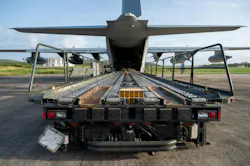
ARLINGTON, Va. - Rune Technologies and Havoc have completed an integration intended to enable autonomous resupply missions in contested and communications-degraded environments by connecting Rune's TyrOS logistics software with Havoc autonomous aircraft.
The companies say they demonstrated the capability on 16 Aug. during the U.S. Army's xTech Overwatch Pegasus Charge III exercise at Fort Hood, Texas, completing an end-to-end autonomous resupply mission. The demonstration followed Army testing of autonomous systems under Project Overwatch and the broader Pegasus Charge initiative at Fort Hood earlier in August.
The integration addresses a key problem in tactical logistics: connecting the software that determines what supplies are needed with autonomous transportation systems capable of moving them.
Related: Army awards $99 million contract for AI-enabled TyrOS logistics platform
Enabling software
TyrOS is designed to provide logistics management at tactical and operational echelons, integrating information on inventory, personnel, equipment and distribution. Rune says the software uses artificial intelligence for decision support, predictive analytics, and optimization and is designed to operate from the tactical edge to enterprise-level systems.
The company's architecture is intended to support logistics operations when communications are intermittent or unavailable. TyrOS uses an offline-first architecture that caches critical inventory, route, and vehicle information locally to support disconnected operation, according to Rune.
The connection to autonomous aircraft comes through Rune's Autonomy Development Kit (ADK), which includes application programming interfaces, documentation, sample code, and optional software libraries. Autonomous-vehicle developers can use the ADK to register an asset and its characteristics, including cargo capacity and cargo class, and to provide TyrOS with telemetry such as fuel or battery status, position and faults. The vehicle can then become a schedulable asset in the TyrOS Task Catalog and receive logistics tasking from the system.
That architecture makes the integration more than a simple aircraft-control connection. TyrOS can incorporate an autonomous aircraft into the logistics planning process, while the aircraft's onboard autonomy handles execution of the assigned mission.
Related: Stratom wins SBIR Phase III contract for autonomous cargo handling
Havoc's software architecture supports autonomous operation at the edge. The company's Havoc OS provides onboard mission execution, autonomy behaviors, navigation, perception and communications, while Havoc Connect provides a peer-to-peer overlay for exchanging commands, telemetry and mission data across intermittent or heterogeneous networks. Havoc says its autonomous systems can continue operating when communications are lost.
Autonomous logistics solutions needed
The Army has established an operational experimentation pathway for the technology. An Army video says soldiers from the 1st Cavalry Division's Ironhorse Brigade conducted autonomous-systems field testing under Project Overwatch and the broader Pegasus Charge initiative at Fort Hood Aug. 10-14. The Army describes Pegasus Charge as an effort to develop and integrate technologies that enhance unit capabilities.
Rune also has an Army procurement pathway for TyrOS. Army Contracting Command awarded Rune a $99 million firm-fixed-price contract June 16 for the TyrOS logistical operations software platform. The contract has an estimated completion date of 15 June 2031, with work locations and funding to be determined through individual orders.
The contract is an indefinite-delivery, indefinite-quantity vehicle rather than a $99 million purchase of the Havoc-Rune capability. Rune says the vehicle enables Army organizations and joint-force partners to procure TyrOS and associated services through task orders.
For autonomous logistics, the integration provides a software link between two traditionally separate functions: determining a unit's sustainment requirements and assigning transportation resources to satisfy those requirements. Rune says TyrOS can identify logistics requirements, generate courses of action, and task autonomous platforms through the ADK, while Havoc provides the autonomous aircraft and software needed to execute those missions.
The integration could allow autonomous aircraft to be managed as logistics assets alongside other transportation resources, while retaining autonomous mission execution at the vehicle level. The companies say they intend the architecture to support sustainment operations in environments where communications and supporting infrastructure may be degraded or denied.
About the Author
Jamie Whitney
Editor-in-Chief
Jamie Whitney joined the staff of Military & Aerospace Electronics in 2018 and oversees editorial content and produces news and features for Military & Aerospace Electronics, attends industry events, produces Webcasts, and oversees print production of Military & Aerospace Electronics.
Related
Voice Your Opinion!
To join the conversation, and become an exclusive member of Military Aerospace, create an account today!
 Leaders Logo
Leaders relevant to this article: