Airbus unveils multi-domain U145 uncrewed helicopter
Key Highlights
- The U145 is an autonomous, uncrewed version of the H145 helicopter, designed for civil and military applications with a planned first flight in late 2026.
- It features a specialized sensor suite and AI capabilities to enable autonomous operations, removing the need for a cockpit in its uncrewed configuration.
- Structural modifications include cargo doors and a dedicated cargo floor, making it suitable for high-volume logistics and multi-mission tasks.
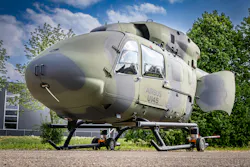
BERLIN - Airbus Helicopters in Marignane, France, introduced its U145 uncrewed rotorcraft at the ILA Berlin airshow, unveiling a full-scale mock-up of an autonomous variant of the H145 designed for civil and military missions.
The U145, derived from the widely fielded H145 platform, marked Airbus’ second crewed-to-uncrewed helicopter conversion effort following the VSR700. The company said a first flight with a safety pilot onboard is planned for late 2026, with entry into service expected early in the next decade.
Airbus positioned the U145 as a mission-agnostic uncrewed aerial system (UAS) intended for high-volume logistics, contested resupply, and modular multi-mission operations.
"With the U145, we are offering our customers an autonomous, uncrewed version of our H145 helicopter — combining the proven airframe, power and useful load of the H145 with the autonomy of a UAS," said Matthieu Louvot, CEO of Airbus Helicopters. "To develop the U145 and its capabilities as a multi-mission UAS, we will be teaming up with leading autonomous mission partners to further expand the UAS ecosystem in Europe."
Autonomy-focused architecture
Unlike the crewed H145, the U145 removes the physical cockpit in its uncrewed configuration and replaces it with an autonomy-enabled mission system. Airbus said the aircraft integrates a specialized sensor suite and artificial intelligence designed to enable autonomous operations.
Airbus has not disclosed subsystem architecture, but an aircraft in this class would typically require a tightly integrated autonomy stack spanning flight control, sensing, and mission execution.
Such architectures generally include:
- Safety-critical flight control computers for rotorcraft stability and envelope protection
- Mission computers supporting navigation, planning, and payload coordination
- Sensor fusion processing integrating electro-optical/infrared, navigation, and obstacle-detection inputs
- Communications systems enabling supervisory control and crewed-uncrewed teaming
- Onboard processing for real-time decision support in contested or communications-degraded environments
Airbus has not confirmed suppliers, processing hardware, or software architecture for these functions on the U145 program. The company confirmed only that the U145 will include a dedicated sensor suite and artificial intelligence capabilities to support autonomous operations.
Modular mission payloads
Compared with the crewed H145, the U145 introduces structural modifications for uncrewed cargo operations, including an integrated nose cargo door with foldable loading table and a dedicated cargo floor.
Related: Near Earth to prototype autonomous resupply aircraft for Marine Corps
With a maximum take-off weight (MTOW) of 3,800 kg, Airbus described the U145 as a modular platform intended primarily for high-volume logistics but adaptable to disaster response, firefighting, armed scouting, and surveillance missions.
The aircraft is also designed to support unmanned teaming and "air-launched effects" operations.
For that role, MBDA is partnering with Airbus to integrate deployable effects systems, positioning the U145 as a potential “mothership” platform for launching smaller uncrewed systems within layered operational concepts.
Distributed autonomy development model
Airbus said it would work with "leading autonomous mission partners" to expand the UAS ecosystem in Europe, reflecting a distributed approach to autonomy development rather than a single vertically integrated stack.
Related: Sikorsky wins Marine Corps contract for R66-based autonomous resupply helicopter
In the United States, Airbus U.S. Space & Defense has been working with autonomy and mission system providers, including Shield AI, L3Harris Technologies, and Parry Labs, on the MQ-72C effort, a UH-72B-based autonomous rotorcraft concept aimed at U.S. Marine Corps requirements.
Airbus has not confirmed whether those same partners are involved in the U145 program. However, the overlap reflects a broader industrial ecosystem spanning autonomy software, mission computing, and secure communications technologies.
The baseline aircraft is powered by twin Safran Helicopter Engines Arriel 2E engines with full authority digital engine control (FADEC).
About the Author
Jamie Whitney
Editor-in-Chief
Jamie Whitney joined the staff of Military & Aerospace Electronics in 2018 and oversees editorial content and produces news and features for Military & Aerospace Electronics, attends industry events, produces Webcasts, and oversees print production of Military & Aerospace Electronics.
Related
Voice Your Opinion!
To join the conversation, and become an exclusive member of Military Aerospace, create an account today!
 Leaders Logo
Leaders relevant to this article: