Navy expands SPY-6 production as modular AESA radar architecture moves across the fleet
Key Highlights
- - The $1.8 billion contract extension supports continued production and sustainment of the SPY-6 AESA radars for the U.S. Navy.
- - The SPY-6 family uses gallium nitride (GaN) technology for higher power density and better energy efficiency, enabling superior threat detection.
- - Modular Radar Modular Assemblies (RMAs) allow scalable and flexible radar configurations across different ship classes.
- - The radars are installed on over 50 Navy ships, including new and legacy vessels, supporting advanced missile defense.
- - Raytheon has invested over $800 million to modernize manufacturing facilities, aiming to double production capacity by 2028.
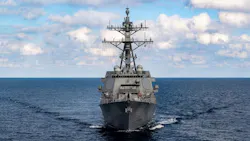
ANDOVER, Mass. - Raytheon, an RTX business, has received a $1.8 billion contract extension from the U.S. Navy to continue production and sustainment of its SPY-6 family of active electronically scanned array (AESA) air and missile defense radars, supporting the service's effort to field a common, modular sensor architecture across multiple classes of surface combatants and aircraft carriers.
The award extends the initial hardware production and sustainment contract awarded in March 2022 and includes options that could increase the cumulative contract value to $3.3 billion.
The SPY-6 family is built around gallium nitride (GaN)-based AESA technology, which offers higher power density and improved energy efficiency than earlier gallium arsenide-based radar designs. The technology enables greater sensitivity and detection range while supporting simultaneous tracking of numerous air and missile threats.
Building blocks
Rather than developing separate radar systems for individual ship classes, the SPY-6 family uses standardized Radar Modular Assemblies (RMAs) as common building blocks. Each self-contained module, measuring approximately 2 feet on each side, can be combined into larger or smaller radar arrays depending on mission requirements while maintaining a common hardware and software architecture across the radar family.
The modular approach is intended to simplify production, logistics, sustainment, and future upgrades while reducing lifecycle costs compared with maintaining multiple independent radar systems.
Seaborne SPY
According to Raytheon, SPY-6 is currently installed aboard two commissioned U.S. Navy ships and 11 additional vessels undergoing testing and is expected to be fielded on more than 50 ships over the next decade.
The radar family is being integrated aboard the Navy's newest Flight III Arleigh Burke-class destroyers, Constellation-class guided missile frigates, Ford-class aircraft carriers, Nimitz-class aircraft carriers, and amphibious warships, while SPY-6(V)4 radars are also being backfitted onto legacy Flight IIA Arleigh Burke-class destroyers.
SPY-6 is designed to detect, track, and discriminate multiple classes of threats simultaneously, including ballistic missiles, hypersonic threats, cruise missiles, aircraft, and surface targets. The radar provides precision tracking and discrimination data to the ship's Aegis Combat System, supporting engagements by the Navy's Standard Missile family and other defensive weapons.
Four primary variants make up the SPY-6 family, each sharing a common technology baseline while scaling radar aperture for different mission requirements. The SPY-6(V)1 radar equips Flight III Arleigh Burke-class destroyers using four fixed array faces composed of 37 RMAs each. The SPY-6(V)4 variant, designed for Flight IIA destroyers, uses 24 RMAs per array face. The SPY-6(V)2 Enterprise Air Surveillance Radar employs a single rotating array for amphibious assault ships and Nimitz-class aircraft carriers, while the fixed-face SPY-6(V)3 configuration is installed aboard Ford-class aircraft carriers and is planned for Constellation-class guided missile frigates.
To support growing fleet demand, Raytheon said it has invested more than $800 million to modernize its radar manufacturing facilities and expand production capacity. The company expects those investments to enable SPY-6 production to double by 2028 as additional Navy platforms enter construction and modernization programs.
