GE Aerospace advances hypersonic test bed under DIU HyCAT
Key Highlights
- GE Aerospace is creating a hypersonic test bed called Derecho, capable of Mach 5 flight, to accelerate hypersonic technology development.
- The dual-mode ramjet technology supports operation across a broad speed range, bridging conventional ramjets and scramjets for versatile testing.
- The DIU HyCAT program aims to provide low-cost, high-cadence airborne testing to overcome current infrastructure limitations and speed up hypersonic innovation.
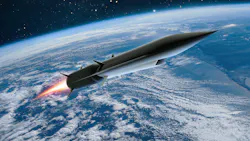
CINCINNATI - GE Aerospace is advancing the development of a hypersonic flight-test platform under a new contract from the Defense Innovation Unit (DIU) as part of the Hypersonic and High-Cadence Airborne Testing Capabilities (HyCAT) program.
Under the new phase of the effort, GE Aerospace will design and develop a combined booster and cruiser system that will form an all-up-round (AUR) test bed for hypersonic flight testing. The work builds on initial funding GE received in 2023 for concept development and team formation.
The new phase will focus on integrating the AUR and conducting initial qualification and component-level testing of key subsystems, according to GE Aerospace. The company advanced subsystem refinement and evaluation in 2024 and completed a preliminary design review of the AUR in 2025.
Related: GE Aerospace, Kratos advance GEK800 toward JASSM second-source role
Aviation Week reports that the GE test bed, known as Derecho, will use an air-breathing dual-mode ramjet designed for flight at about Mach 5. The vehicle is expected to be air-launched, with a solid rocket motor accelerating the cruiser to the conditions required for dual-mode ramjet operation.
Dual-mode ramjet development
GE has been developing its dual-mode ramjet technology since 2023. The propulsion approach is intended to bridge the operating regimes of conventional ramjets and scramjets, with the dual-mode configuration supporting operation across a broader speed range. GE has also conducted ground testing as it develops the flight-test system.
The need for additional flight-test capacity reflects a broader challenge in hypersonic technology development. DIU launched HyCAT in early 2023 specifically to provide low-cost, high-cadence airborne testing for the hypersonics community. DIU says the program is intended to accelerate evaluation and transition of emerging technologies through low-cost, responsive and long-endurance flight testing.
DIU has described the shortage of affordable, reusable and high-cadence test platforms as a national bottleneck for hypersonic development. The agency says wind-tunnel testing, while valuable, is reaching capacity, creating demand for alternative approaches to flight testing. In March 2026, DIU reported that its Cassowary Vex mission demonstrated sustained, maneuverable air-breathing flight at speeds exceeding Mach 5 using a commercially derived test architecture.
Related: Electronic subsystems for hypersonic flight aim for new levels of rugged
Ground testing remains an important part of the development process. The Government Accountability Office has reported that hypersonic wind tunnels are essential for testing components and validating designs before flight, but that recreating the extreme conditions experienced during hypersonic flight is difficult. Flight tests, ground tests, models, and simulations therefore complement one another in validating performance and reducing technical risk. GAO also found that U.S. hypersonic wind-tunnel infrastructure is aging and that demand for available facilities has increased.
Flight testing creates its own logistical challenges. GAO reported that hypersonic test programs need sensor coverage along the flight path to collect data, while open-ocean testing can require ships to carry sensors to remote locations. Test ranges and associated instrumentation also must be shared with other high-priority programs. The agency noted that the Department of Defense has been developing additional flight corridors and aerial sensor capabilities to increase testing capacity and reduce reliance on ground- and sea-based instrumentation.
About the Author
Jamie Whitney
Editor-in-Chief
Jamie Whitney joined the staff of Military & Aerospace Electronics in 2018 and oversees editorial content and produces news and features for Military & Aerospace Electronics, attends industry events, produces Webcasts, and oversees print production of Military & Aerospace Electronics.
Related
Voice Your Opinion!
To join the conversation, and become an exclusive member of Military Aerospace, create an account today!
 Leaders Logo
Leaders relevant to this article: