B-21 Raider demonstrates weapons-release capability as testing advances
Key Highlights
- The first publicly announced B-21 weapons-release test took place during the first week of November at Edwards Air Force Base.
- The Air Force did not identify the weapon or disclose further details about the demonstration.
- Thousands of hours of digital-twin modeling helped the test team predict and refine the weapon’s trajectory.
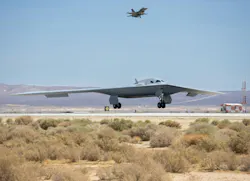
EDWARDS AIR FORCE BASE, Calif. - The U.S. Air Force's B-21 Raider long-range stealth bomber has demonstrated conventional weapons-release capability during flight testing, marking a milestone in the aircraft's development as the service prepares to receive its first operational aircraft at Ellsworth Air Force Base, S.D., in 2027.
The test, conducted during the first week of November at Edwards Air Force Base, Calif., involved a B-21 test aircraft releasing a conventional weapon. The Air Force did not identify the weapon or disclose additional details about the demonstration. The service described the test as a transition from flight testing toward a functional weapons platform. It represents the first publicly announced B-21 weapons-release demonstration.
Digital modeling
The USAF said the test validated the aircraft's digital models and the maturity of its open-systems architecture. The B-21 Combined Test Force used thousands of hours of virtual modeling within the aircraft's digital-twin environment to predict and refine the weapon's trajectory before the flight demonstration.
Related: Northrop Grumman wins $29.2 million Navy contract for AN/WSN-12 navigation systems
Digital engineering enables aircraft developers and test personnel to use computer-based models to evaluate system performance and prepare for physical testing. In the B-21 program, the digital-twin environment supports weapons integration and helps the test team evaluate weapon trajectories before flight demonstrations.
The B-21's open-systems architecture is intended to reduce integration risks and enable future modernization efforts as operational requirements and threats evolve. The Air Force identifies the architecture as a way to support the introduction of new technologies and capabilities throughout the aircraft's service life.
Next-gen long-range bomber
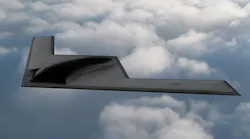
Northrop Grumman is developing the B-21 as the Air Force's next-generation long-range penetrating strike bomber. The aircraft is designed to penetrate advanced air-defense environments and deliver conventional and nuclear weapons against targets in heavily defended territory. It will eventually replace the B-1B Lancer and B-2 Spirit bombers and operate alongside the B-52 Stratofortress as part of the Air Force's future bomber fleet.
The Air Force describes the B-21 as part of a broader family of systems for conventional long-range strike, including intelligence, surveillance and reconnaissance (ISR), electronic attack, communications, and other capabilities. The aircraft is also being designed to employ a mix of stand-off and direct-attack munitions.
Related: How targeting pods help fighter aircraft find and track targets
The service has not publicly disclosed detailed specifications for the B-21's onboard radar, electronic warfare equipment, sensors, or mission-processing systems. However, the Air Force has identified advanced stealth, resilient networking, and a modern, data-driven command-and-control architecture as elements of the aircraft's design.
The weapons-release demonstration comes as the Air Force and Northrop Grumman expand aircraft testing and manufacturing capacity. The service is targeting 2027 for the arrival of B-21 aircraft at Ellsworth Air Force Base, which will serve as the bomber's first main operating base and formal training location. The aircraft's arrival target should be distinguished from initial operational capability, which Air Force Global Strike Command previously identified as planned for 2028.
The Air Force and Northrop Grumman agreed in February 2026 to increase annual B-21 production capacity by 25 percent. The expansion uses $4.5 billion in funding already authorized and appropriated under fiscal 2025 reconciliation legislation to accelerate aircraft deliveries.
Northrop Grumman is also expanding its manufacturing infrastructure to support production. The company opened a new manufacturing facility at its Layton, Utah, campus in September 2026 and broke ground on a planned 1-million-square-foot final-assembly facility at Air Force Plant 42 in Palmdale, Calif.
The Air Force's program objective remains a minimum fleet of 100 B-21 aircraft. The program is progressing through concurrent development, production, and flight testing as the service prepares to introduce the bomber into its long-range strike force.
About the Author
Jamie Whitney
Editor-in-Chief
Jamie Whitney joined the staff of Military & Aerospace Electronics in 2018 and oversees editorial content and produces news and features for Military & Aerospace Electronics, attends industry events, produces Webcasts, and oversees print production of Military & Aerospace Electronics.
Voice Your Opinion!
To join the conversation, and become an exclusive member of Military Aerospace, create an account today!
 Leaders Logo
Leaders relevant to this article: