TLANT 3D launches atomic-scale fabrication platform for materials and device development
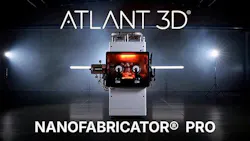
COPENHAGEN - ATLANT 3D has launched NANOFABRICATOR PRO, a programmable atomic-scale fabrication platform designed to connect computational materials discovery with physical fabrication, validation, and device prototyping.
The system uses ATLANT 3D's Direct Atomic Layer Processing (DALP) technology, which selectively deposits materials through a localized microreactor rather than applying a uniform coating across an entire substrate. The approach enables digitally controlled material patterning and rapid experimentation without conventional photomasks.
ATLANT 3D says NANOFABRICATOR PRO can support more than 450 material families and applications, including RF and microelectronics, advanced semiconductor packaging, photonics, MEMS and sensors, and quantum technologies. The company describes the platform as a way to fabricate and experimentally validate materials generated through computational or AI-based discovery workflows.
The DALP process supports selective-area deposition and multimaterial structures, with material processing performed directly on defined areas of a substrate. ATLANT 3D's published technology specifications describe atomic-scale vertical control, with lateral resolution dependent on the processing configuration. The company's technology also supports deposition on complex surfaces and sequential processing of multiple materials.
For semiconductor and electronic-device development, the approach lets researchers test different materials, layer structures, and process conditions without fabricating an entire substrate through a conventional sequence of lithography, deposition, and etching steps. ATLANT 3D says NANOFABRICATOR PRO is intended for industrial research and development and can process substrates up to 8 inches (200 cm).
The company is industrializing the platform with Automated Industrial Robotics, which it says is manufacturing the system in the United States. ATLANT 3D describes NANOFABRICATOR PRO as a SEMI-compliant platform intended to support a transition from materials experimentation toward repeatable manufacturing processes.
The platform is also intended to retain digital fabrication recipes and process information alongside physical results, allowing experimental data to inform subsequent materials and process development. ATLANT 3D says this workflow is intended to shorten the path from computational materials predictions to experimentally validated materials and prototype devices.
For more information, visit https://atlant3d.com/.