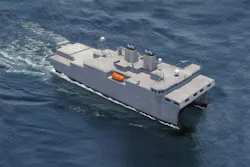
ARLINGTON, Va. - GE Aerospace in Evendale, Ohio, has received an order from Austal USA in Mobile, Ala., to provide propulsion technology for the U.S. Navy's new Explorer-class ocean surveillance ships under the T-AGOS 25 program.
The agreement covers one LM2500+G4 marine gas turbine in a composite enclosure, along with an associated generator from Brush Electric Machines in Loughborough, UK, for the lead ship, USNS Don Walsh (T-AGOS 25), now under construction at Austal USA's shipyard in Mobile.
The Explorer-class ships are designed to support the Navy's anti-submarine warfare operations and the Integrated Undersea Surveillance System (IUSS). The vessels will use an integrated electric propulsion architecture that combines four electric motors, powered by three diesel generators and one LM2500 gas turbine.
Related: GE Aerospace demonstrates AI-assisted hypersonic propulsion design
According to GE Aerospace, the hybrid propulsion arrangement enables the ships to operate efficiently during low-speed towing missions while also providing higher-speed transit capability when needed. The ships are expected to operate at speeds up to 22 knots.
Explorer-class details
The Explorer class will replace the Navy's aging T-AGOS fleet, which currently consists of four Victorious-class ships commissioned between 1991 and 1993 and the Impeccable-class USNS Impeccable (T-AGOS 23), commissioned in 2000. The existing ships support SURTASS, or Surveillance Towed-Array Sensor System, operations that gather and process undersea acoustic data for anti-submarine warfare missions.
At 359 feet in length and roughly 9,099 tons displacement, the Explorer-class ships will be the largest and fastest T-AGOS vessels operated by the Navy. The first two ships in the class, T-AGOS 25 and T-AGOS 26, are named Don Walsh and Victor Vescovo, respectively.
The LM2500 gas turbine aboard USNS Don Walsh will use GE Aerospace's composite enclosure technology, which the company says reduces enclosure weight by approximately 50% compared to steel versions while lowering engine room noise and reducing maintenance requirements. The enclosure also has MIL-S-901D Grade A shock qualification for naval operations.
Related: Lockheed Martin to build two additional TL-29A towed-array sonar systems to detect quiet submarines
GE Aerospace says the composite enclosure reduces engine room noise by as much as 60% compared to earlier steel enclosures, an important consideration for acoustic surveillance missions. The company also says the carbon-fiber enclosure lowers engine room temperatures and improves corrosion resistance while simplifying engine removal and maintenance access.
Program background
Congress approved the procurement of the first Explorer-class ship in fiscal 2022. The Navy's proposed fiscal 2026 budget requests $612.2 million to procure the second ship in the class.
The T-AGOS 25 program has faced technical and schedule challenges. A June 2025 Government Accountability Office report said shortages in ship design resources and delays in vendor information slowed progress on the lead ship design. The report also cited technical risks associated with developing a Small Waterplane Area Twin Hull, or SWATH, vessel meeting the Navy's speed, endurance, and seakeeping requirements.
The Navy plans to procure seven Explorer-class ships to replace the current fleet.