Nullspace releases electromagnetic simulation suite for faster RF and antenna design
Key Highlights
Questions and Answers
Q: What problem is the new software designed to address? A: The software targets long simulation times and cumbersome CAD cleanup processes caused by mechanical design features that do not affect RF performance but slow electromagnetic analysis.
Q: How does Nullspace Prep change the CAD-to-RF workflow? A: Nullspace Prep uses AI-based automation to help RF engineers remove nonessential CAD features themselves, reducing the need for repeated file exchanges between mechanical and RF design teams.
Q: What new modeling capabilities are included in the release? A: The software adds passive circuit load modeling, allowing engineers to include electrically small impedance loads and lumped circuit elements when analyzing phased arrays, tunable antennas, and other advanced RF systems.
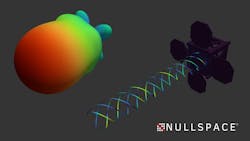
HUNTSVILLE, Ala. - Nullspace Inc., an engineering software company in Huntsville, Ala., focused on modernizing simulation tools for mission-critical radio frequency (RF) applications, has announced the release of a new electromagnetic simulation suite designed to accelerate RF analysis and streamline design workflows for antenna and radar systems.
When developing RF systems for satellite, communications, and defense applications, Nullspace says engineers often work with computer-aided design (CAD) files that include features required for mechanical design but that do not affect RF performance. These extraneous features can slow electromagnetic simulations and complicate design iterations, making accurate RF analysis more time-consuming.
With many legacy electromagnetic simulation tools, CAD files must be repeatedly transferred between mechanical design teams and RF engineers to remove nonessential features and prepare models for simulation. This iterative process can be lengthy and labor-intensive.
AI integrated
The new Nullspace Prep tool, part of the company’s RF tools suite, is designed to make CAD cleanup directly accessible to RF engineers. The company says that the software incorporates AI-based automation to reduce the need for repeated handoffs between tools and departments, enabling engineers to prepare CAD files for electromagnetic simulation more quickly and efficiently.
The latest release of Nullspace EM also introduces fast adaptive frequency sweeps, which the company says can deliver up to 100x faster simulation times for full-fidelity electromagnetic analysis. The tool combines high-accuracy EM simulation, a proprietary matrix compression algorithm, and adaptive frequency sampling to reduce computational effort across wide frequency ranges.
In many antenna and microwave design applications, engineers must analyze RF performance across a defined frequency band. Traditionally, users manually selected discrete frequency points for simulation, a process that could be time-consuming and risk missing important effects such as unwanted resonances.
Related: NRO selects Umbra for second phase of commercial RF study
Fast adaptive frequency sweeps enable physics-informed interpolation across a user-defined frequency range. Engineers specify the start and end frequencies, and the software automatically determines optimal sampling points. According to the company, this approach enables significant speed improvements for applications such as wideband antennas, phased arrays, and on-body RF analysis.
The new release also adds passive circuit load modeling to support more realistic RF system simulations. The feature allows engineers to include electrically small impedance loads in electromagnetic models, which are commonly used in large phased arrays and other advanced RF systems.
With this capability, users can analyze antenna terminations and tunable lumped circuit elements when designing systems such as tunable leaky-wave antennas and metasurfaces. The company says the feature enables faster impedance matching optimization and more accurate system-level performance analysis.
