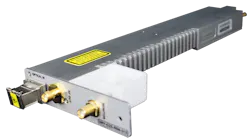
In modern defense arenas and environments, mission success depends on reliable systems that increasingly need to separate the radiating elements from the Command Posts (CP) over relatively long distances. This offers the benefit of improving system performance and the security level at the CP. On the other hand, current solutions in connectivity are reaching their limits, due to the losses incurred by conventional copper connectivity and due to the “sensitivity” to electromagnetic interferences (EMI). All these aspects can be solved by RF-over-Fiber (RFoF) technology that converts analogue RF signals to light, in order to transport them through optical fiber and then make the opposite conversion at the destination.
Moving RF communication beyond the limits of coaxial cable
RFoF architecture has the potential to exceed the practical reach of coaxial cable connectivity. The HUBER+SUHNER RFoF portfolio, for instance, supports distances of up to 100 km without amplification and frequencies from 20 MHz to 40 GHz. Fiber is also lighter than copper, which enables wavelength-division multiplexing, which can place tens of channels on a single fiber.
For platform designers, that combination of channels can reduce cable weight and footprint without forcing antennas, receivers and processing equipment to be placed in the same location.
Increased Command and Control capabilities: extending the antenna
Mobile Command and Control (C2) shelters show the value of antenna remoting. With RFoF connectivity, antennas can be positioned away from the CP while reducing the number of copper lines passing through a Faraday cage. As optical links are intrinsically immune to electromagnetic and radiofrequency interference, as well as electromagnetic pulse, they are notoriously difficult to intercept.
Where power is unavailable at the remote end, Power-over-Fiber can also support equipment that needs to be installed away from convenient electrical sources. Combined with all-optical switching, wavelength-division multiplexing and fiber-management solutions, RFoF creates a flexible connectivity architecture for rapidly deployed ground stations.
Improved SWaP for vehicles and tethered payloads
Inside armoured vehicles, available space and weight are critical factors and are therefore tightly constrained. GPS-over-Fiber can distribute a single GPS signal to multiple receivers using compact conversion modules and small-diameter fiber. When combined with Power-over-Fiber, the system provides galvanic isolation between the antenna and internal modules. A single common, frequency-agnostic fiber infrastructure such as this can also support positioning, navigation and timing, communications, intelligence, surveillance and reconnaissance, and electronic-warfare payloads.
The same SWaP advantages can also be applied to tethered drones, aerostats and other cabled payloads. Lightweight hybrid cables can carry signals while heavy processing or conditioning equipment remains at the ground station. This preserves payload capacity and keeps operators farther away from exposed positions.
Connectivity across radar, electronic warfare and naval platforms
There’s increased use of RFoF technology in radar and electronic warfare systems as well. They benefit from the freedom to place antennas where transmission and reception are most effective, while locating personnel and processing equipment elsewhere. High-bandwidth optical links do not affect the spectrum quality of the received bounced-back signals from the threads, and mobile phased arrays can operate without carrying all signal-processing equipment onboard.
On naval vessels, RF equipment may be separated from receiver and processing systems by significant distances, while dense connectivity increases cable-management pressure. Scalable RFoF links can reduce the cable footprint and serve navigation, satellite communications, INMARSAT, COMINT, ELINT and electronic-warfare antenna systems. Moving down converters and digitizers away from payloads and towards the ship's center of gravity can also improve stability.
Designing the complete link
RFoF performance depends on a reliable portfolio of components, conversion modules, optical switching, fiber management, environmental resilience and the wider RF architecture. HUBER+SUHNER offers chassis-, panel- and DIN-mountable converters, customized form factors, modular hubs and systems designed for shock, vibration and broad operating temperatures.
For operators in aerospace and defense environments, the central benefit that RFoF provides is architectural flexibility. RFoF can separate antennas from operators, consolidate many channels, reduce weight and create a shared optical foundation that can be reconfigured as missions and payloads change.
As applied frequencies continue to increase in these environments to accommodate greater data loads, RFoF can offer indispensable solutions for modern mission-critical connectivity.