Hermeus to advance high-Mach uncrewed aircraft under expanded DIU agreement
Key Highlights
- Hermeus's contract with the DoD has been expanded to a total of $219 million to support high-Mach flight demonstrations.
- The company plans to conduct flight tests in 2026 and 2027 to evaluate aircraft performance and payload release at high speeds.
- Hermeus's Quarterhorse Mk 2.1 aircraft achieved Mach 1.21 during recent supersonic flight testing.
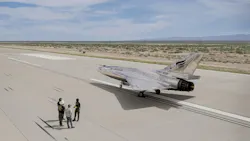
LOS ANGELES - Hermeus in Los Angeles has secured a $159 million Other Transaction Agreement (OTA) modification from the Defense Innovation Unit (DIU), an organization within the U.S. Department of Defense (DoD) focused on accelerating the adoption of commercial technology for military applications.
The modification increases the total agreement ceiling to $219 million and expands work to demonstrate high-Mach flight and high-speed payload release. The award is part of an Other Transaction Authority (OTA) agreement structure used to rapidly develop and transition prototype capabilities for defense applications. The modification is among the larger DIU agreement expansions disclosed publicly.
Under the expanded scope, Hermeus will work with the U.S. Air Force and U.S. Navy to demonstrate the ability of uncrewed aircraft to achieve high-Mach speeds and release payloads in flight, supporting future operational concepts for high-speed, long-range missions.
"This program is about moving high-Mach capability out of the lab and into an operationally relevant environment," said AJ Piplica, CEO and co-founder of Hermeus. "By delivering flight-ready aircraft and demonstrating payload release at speed, we will prove this technology can create a decisive military advantage on a timeline that matters. Our focus is on providing the Air Force and Navy with the validated data they need to transition these platforms into the future force."
Flight testing
Hermeus said it will conduct a series of flight tests in 2026 and 2027 to evaluate aircraft performance at high speeds and assess payload release capabilities under high-speed flight conditions. Test data will inform service experimentation and future acquisition decisions.
"As you look towards the future, and the military problems we're facing, the issues are generally around time and distance, and how do you get to these far-off places at a timeframe that matters," said DIU Military Deputy Maj. Gen. Joe "Solo" Kunkel. "I care about the warfighting capability, providing advantage to our partners and us in the fight, and making sure that we can walk into every fight with swagger. If we can mass produce this, then it becomes a game-changing warfighting capability, where we use it as a weapon instead of a test platform, and I think we found a significant number of use cases where it can be used as a weapon."
Hermeus said its work with Air Force and Navy stakeholders is intended to align flight testing with future mission needs and reduce the transition time from demonstration to operational capability.
The announcement follows Hermeus’ recent flight testing of its Quarterhorse Mk 2.1 aircraft, which achieved a top speed of Mach 1.21 during a supersonic test flight conducted from Spaceport America over White Sands Missile Range airspace.
Hermeus said the aircraft reached supersonic flight on its third test flight and approximately one year after the maiden flight of its first demonstrator, Quarterhorse Mk 1.
"Our customers at the Department of War are paying close attention to how fast this program is moving," said Piplica. "This flight demonstrates a pace of execution that is extremely rare in modern aviation. Our country's ability to deliver new asymmetric military capability at scale depends on teams that can solve hard technical challenges quickly. That's exactly what we're proving with each test flight we conduct and each new aircraft we build at Hermeus."
Supersonic demonstrators
Quarterhorse Mk 2.1 is the first of three F-16-class supersonic demonstrators in the company’s development roadmap and is powered by a Pratt & Whitney F100 engine, built by Pratt & Whitney, an RTX business. Hermeus is developing successive aircraft iterations to expand performance and reduce risk through rapid flight testing cycles.
The company is currently building its next aircraft, Quarterhorse Mk 2.2, with Mk 2.3 also in development. Each iteration is intended to advance toward sustained high-Mach flight and expand the platform’s operational envelope.
About the Author
Jamie Whitney
Editor-in-Chief
Jamie Whitney joined the staff of Military & Aerospace Electronics in 2018 and oversees editorial content and produces news and features for Military & Aerospace Electronics, attends industry events, produces Webcasts, and oversees print production of Military & Aerospace Electronics.
Related
Voice Your Opinion!
To join the conversation, and become an exclusive member of Military Aerospace, create an account today!
 Leaders Logo
Leaders relevant to this article: