JAGM fired from containerized GRIZZLY launcher in Lockheed Martin counter-UAS test
Key Highlights
- The live-fire test integrated radar sensing, battle management software, and missile effects into a seamless engagement chain.
- Lockheed Martin's GRIZZLY system is a portable, containerized launcher designed for rapid deployment and reduced infrastructure needs.
- The demonstration used Fortem R-40 radar to detect and track a Group 3 drone, with Sanctum software managing the engagement process.
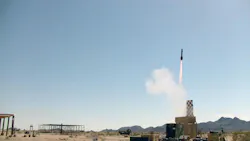
BETHESDA, Md. - Lockheed Martin has demonstrated a counter-uncrewed aerial system (UAS) engagement using a Joint Air-to-Ground Missile (JAGM) launched from its GRIZZLY containerized launcher during a live-fire test that integrated radar sensing, battle management software, and missile effects into a single engagement chain, according to company information and supporting reports.
The demonstration, conducted at Yuma Proving Ground, Ariz., involved the detection, tracking, and engagement of a Group 3 one-way attack test drone using Fortem R-40 radar systems, Lockheed Martin’s Sanctum counter-UAS battle management software, and the GRIZZLY containerized launcher.
Lockheed Martin said the integrated system executed a full detect-to-engage sequence in which sensor data from radar systems was processed through the Sanctum mission management software to generate an engagement solution. The GRIZZLY launcher then fired a Joint Air-to-Ground Missile that intercepted the target.
Related: Echodyne provides radar for Air Force SUADS counter-drone architecture
The company described the effort as a live-fire demonstration combining hardware-in-the-loop testing and field integration activities completed over a compressed development timeline. Specific program timelines, quantities, and configuration details were not disclosed.
GRIZZLY concept
The GRIZZLY system is a containerized launcher concept developed by Lockheed Martin, designed to provide a mobile, self-contained missile-launch capability using a standardized container form factor. The system is intended to reduce infrastructure requirements compared with fixed air defense launcher installations and to support the rapid deployment of missile-based defensive capabilities.
The Joint Air-to-Ground Missile used in the demonstration is a precision-guided weapon used by U.S. forces for close air support and precision engagement missions. In this configuration, it was employed as a kinetic effector within a counter-uncrewed aerial system architecture. The missile incorporates a guidance system that can include semi-active laser and millimeter-wave radar modes depending on configuration and employment.
Related: Electronic subsystems for hypersonic flight aim for new levels of rugged
Lockheed Martin’s Sanctum software suite is part of the company’s counter-UAS portfolio and is designed to integrate sensor inputs, battle management functions, and effector coordination to support engagement decision-making within a networked air defense architecture.
Radar integration
The demonstration integrated Fortem Technologies radar systems to provide target detection and tracking data, which was then processed by the Sanctum system to support engagement of the uncrewed aerial target. Fortem R-40 radar systems have been used in a range of counter-UAS demonstrations and integration efforts across industry and defense testing environments.
The containerized launcher concept is designed to support deployment on ground-based sites and potentially other platforms, enabling a distributed approach to short-range air defense and counter-UAS missions. Lockheed Martin has characterized the architecture as part of a modular approach to integrating sensors, command-and-control systems, and effectors for layered defense applications.
The company said the system is designed to operate as part of a networked architecture that can be integrated with higher-level command and control systems or operate in a more standalone configuration, depending on mission requirements.
The demonstration reflects broader U.S. defense interest in distributed and rapidly deployable counter-UAS capabilities, particularly for the protection of fixed installations and forward-deployed assets against small uncrewed aircraft threats.
The Joint Air-to-Ground Missile is part of the U.S. military’s precision-strike inventory and has been integrated across multiple platforms for both ground and air launch applications. Its use in counter-UAS demonstrations reflects ongoing experimentation with existing missile systems in expanded air defense roles.
The company said the test contributes to continued evaluation of integrated sensor-to-shooter architectures for counter-UAS missions, but did not provide details on future deployment plans or acquisition status.
About the Author
Jamie Whitney
Editor-in-Chief
Jamie Whitney joined the staff of Military & Aerospace Electronics in 2018 and oversees editorial content and produces news and features for Military & Aerospace Electronics, attends industry events, produces Webcasts, and oversees print production of Military & Aerospace Electronics.
Related
Voice Your Opinion!
To join the conversation, and become an exclusive member of Military Aerospace, create an account today!
 Leaders Logo
Leaders relevant to this article: