What is an uncrewed aircraft and how does it actually fly without a pilot onboard?
Key Highlights
- Uncrewed aircraft can be controlled remotely or operate autonomously using onboard computers and sensors.
- The command-and-control (C2) data link is essential for transmitting instructions and receiving aircraft status updates from ground operators.
- Flight computers constantly adjust aircraft orientation using sensors like gyroscopes and accelerometers to maintain stable flight.
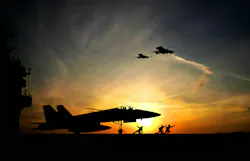
NASHUA, N.H. — An aircraft does not need someone sitting in a cockpit to fly, but it does still need many of the same basic functions a conventional aircraft does. An uncrewed aircraft can be a small multirotor that weighs only a few pounds or a much larger fixed-wing aircraft with an airplane-like design. What they have in common is that nobody onboard directly controls the flight.
That does not mean nobody is controlling the aircraft at all. Depending on the system, a remote pilot may send commands from the ground or onboard computers may handle portions of the flight automatically. In some cases, the aircraft combines both approaches.
Understanding how that works starts with an important distinction between the plane and everything supporting it.
Related: Why commercial aircraft cruise around 35,000 feet
An uncrewed aircraft is one part of a larger system
The terms "drone," "uncrewed aircraft" and "uncrewed aircraft system" often get used interchangeably, but they do not describe exactly the same thing. The aircraft itself is the vehicle that flies. The Federal Aviation Administration (FAA) defines an unmanned aircraft as a vehicle operated without the possibility of direct human intervention from within or on the aircraft.
Put simply, an uncrewed aircraft system (UAS) includes the vehicle itself and the equipment necessary to operate it. Depending on the system, that can include a ground control station, communications tools and other supporting hardware.
The pilot can control the aircraft from somewhere else
In a remotely piloted system, commands have to travel from the operator to the aircraft. A command-and-control, or C2, data link provides that connection. The operator can use it to send instructions to the aircraft while receiving information about its status in return. NASA describes C2 as the radio link that allows a remote pilot to maintain control of an uncrewed aircraft and receive data from it.
The amount of direct control can vary. An operator might command a small aircraft using handheld controls, while a larger UAS may use a ground control station with displays and controls that resemble some of the functions found in a cockpit.
The operator also does not necessarily have to steer the aircraft continuously. A command might tell the system to maintain a particular altitude or follow a planned route, leaving onboard electronics to make the smaller corrections required along the way.
A flight computer makes constant corrections
Keeping an aircraft in the air involves constant adjustments. Wind, turbulence and the aircraft's own movements can change its orientation. Sensors such as gyroscopes and accelerometers can measure rotation and acceleration, giving the flight-control system information about how the aircraft is moving.
The flight computer can use those measurements to make corrections. On a multirotor, for example, the system can change the speed of individual motors to control how the aircraft climbs, descends, turns or tilts.
A fixed-wing uncrewed aircraft works differently. Like a conventional airplane, it can use aerodynamic control surfaces to change its motion. The flight-control system can direct those surfaces rather than relying on a pilot physically moving cockpit controls.
This is one reason an aircraft can appear to fly steadily even when the operator is not making constant control inputs. Onboard electronics handle many of the rapid adjustments needed to maintain the commanded flight.
Navigation tells the aircraft where it is
Many uncrewed aircraft use satellite navigation such as GPS to determine position. Other onboard sensors can provide information about speed, direction, altitude and movement.
Inertial sensors are particularly useful because they measure motion without requiring an outside radio signal. Their measurements can be combined with GPS and other navigation sources to give the flight computer a better estimate of where the aircraft is and how it is moving.
That information allows the aircraft to follow a planned route. Instead of an operator steering toward each destination manually, a mission can use a series of geographic points, or waypoints. The flight-control system then works to move the aircraft from one point to the next.
More advanced UAS can use additional navigation methods when GPS becomes unreliable or unavailable, but the basic requirement remains the same: the aircraft needs enough information about its position and motion to control where it goes.
Related: What happens when an aircraft loses GPS?
Not every sensor is used to fly the aircraft
Uncrewed aircraft can carry cameras, infrared sensors, radar and other equipment, but those technologies do not necessarily control the flight. Some sensors support the aircraft itself. An inertial sensor, for example, can help determine how the vehicle is moving. Other sensors are part of the mission payload.
A camera might collect imagery for surveillance or inspection. An infrared sensor can detect energy outside the visible spectrum, while radar can provide information about objects or terrain depending on the application.
That information can stay onboard for processing or travel across a data link to an operator somewhere else. This gives the person on the ground access to information collected from the aircraft without having to be physically aboard it.
Takeoff and landing depend on the aircraft
Uncrewed aircraft do not all get into the air the same way. For example, a fixed-wing UAS may use a runway much like a conventional airplane. Smaller systems can use launchers or other methods when a runway is unavailable. Multirotors can take off and land vertically by changing the thrust produced by their motors.
Some vehicles combine the two approaches. A vertical-takeoff-and-landing (VTOL) aircraft can rise without a runway and then transition to wing-borne flight for the rest of its mission. The amount of operator involvement can vary here, too. Some systems allow a remote pilot to control takeoff and landing, while others can automate portions or all of those procedures.
Losing the link does not necessarily mean losing the aircraft
Moving the pilot away from the aircraft introduces a problem that a conventional cockpit does not have: the communications link can disappear. Terrain, distance, interference or equipment problems can interrupt the connection between the operator and aircraft. The response depends on how the particular UAS is designed and programmed.
Rather than waiting indefinitely for another command, a system can have predetermined instructions for a lost-link event. Those instructions might direct the aircraft to continue along a planned route, hold at a designated location, return toward a recovery point or land when appropriate.
That does not make every uncrewed aircraft autonomous. It means engineers can give the flight-control system procedures for situations in which the operator cannot immediately send another instruction.
About the Author
Samantha McGrail
Associate Editor
Related
Voice Your Opinion!
To join the conversation, and become an exclusive member of Military Aerospace, create an account today!
 Leaders Logo
Leaders relevant to this article: