FAA expands research into spectrum, communications risks of autonomous airport vehicles
Key Highlights
- The FAA added research topics on lost communications and spectrum interference in October 2026, following a cybersecurity topic added in September.
- The research covers autonomous vehicles used for towing, baggage transport, de-icing, shuttles, inspections, and other airport tasks.
- Researchers are asked to assess how vehicles should respond to communications outages and safely resume operations when links are restored.
- The spectrum topic addresses interference risks between autonomous vehicles and airport systems such as navigation aids, radar, and debris-detection equipment.
- Each topic anticipates a research period of no more than 12 months.
WASHINGTON - The Federal Aviation Administration (FAA) is seeking applied research into cybersecurity vulnerabilities, communications failures, and radio-frequency spectrum interference associated with autonomous ground vehicle systems (AGVS) operating at airports. The agency added research topics addressing lost communications and spectrum interference in October, expanding its research agenda for autonomous vehicles operating in airport environments.
The topics appear in Amendment 014 to the FAA's Aviation Research 2025 Broad Agency Announcement (BAA), dated 3 Nov. 2026. The cybersecurity topic, ARAS0014, was added in Amendment 012 on 29 Sept. 2026. Amendment 013, issued 19 Oct. 2026, added ARAS0015 on lost communications and ARAS0016 on spectrum interference.
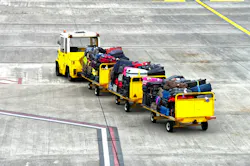
The research addresses potential safety, integration, and validation challenges associated with airport automation. The FAA identifies autonomous ground vehicles used for tasks such as aircraft towing, baggage transport, de-icing, employee shuttles, foreign object debris collection, and perimeter inspections, as well as self-driving jet bridges.
Spectrum interference
Under ARAS0016, the FAA wants researchers to develop methods to identify and mitigate potential spectrum interference between autonomous ground vehicles and other airport equipment.
The agency is concerned both that autonomous vehicles could affect frequencies used by airport systems and that existing airport equipment could interfere with vehicle systems. Equipment identified in the research topic includes FAA navigation aids, avian radar, uncrewed aircraft detection systems, and foreign object debris detection systems.
Related: How do airlines turn passenger planes into cargo aircraft?
The FAA seeks approaches to identify frequencies used by autonomous vehicles and airport communications, navigation, and surveillance infrastructure, then assess potential interference risks to both. The analysis should account for communications equipment beyond the vehicles themselves, including command-and-control systems and vehicle communications devices.
The topic also calls for approaches to establishing policies to identify and address spectrum interference risks. The anticipated period of performance for resulting research projects is no more than 12 months.
Lost communications
The ARAS0015 topic addresses how autonomous ground vehicles should behave when they lose communications with command-and-control (C2) systems monitored by human operators.
Although autonomous, these vehicles typically maintain wireless links with their C2 systems so operators can initiate or end tasks and abort missions when necessary. The FAA notes that these links can fail temporarily or for longer periods, creating a need for procedures that account for outage duration and the vehicle's intended task.
Related: FAA certifies Boeing 737 MAX 10 as airlines prepare for deliveries and fleet upgrades
The agency wants researchers to assess existing industry procedures and recommend improvements or new approaches for vehicles operating in airport movement areas. Questions include when a vehicle should continue its task, stop immediately, move to a safe area, or abort its mission and return to its home base.
Research also should address how vehicles should behave after communications are restored, including whether they should resume their missions, remain stationary, relocate to a temporary safe area, or return to base. The FAA calls for safety analysis of proposed procedures and vehicle behavior. The anticipated research period is no more than 12 months.
Cybersecurity risks
The FAA's ARAS0014 topic focuses on identifying and mitigating cybersecurity risks associated with autonomous ground vehicles operating in airport environments, including movement areas, non-movement areas, and remote areas such as airport perimeter fences.
The research should identify vulnerable components across the vehicle system, potentially including centralized C2 infrastructure and tablets or smartphones airport personnel use to communicate with and control vehicles.
The FAA also seeks approaches to validate cybersecurity protections after vehicles enter airport service, prevent attacks, detect attempted and successful attacks during operations and periodic evaluations, and respond when an attack succeeds. Response research should address immediate risk mitigation and procedures for safely returning an affected vehicle to normal operations.
Together, the three topics address connected engineering challenges in deploying autonomous systems within complex airport environments. Vehicle communications must remain reliable enough to support safe operations, wireless systems must coexist with airport communications and navigation infrastructure, and cybersecurity protections must account for the broader systems used to monitor and control vehicles.
The research priorities may affect secure embedded computing, wireless communications, spectrum management, electromagnetic compatibility, vehicle control systems, and autonomous-system validation. The FAA is soliciting research approaches to better understand and mitigate these risks rather than prescribing a specific technical solution.
The FAA named Stephen Jenniss as the primary point of contact for this BAA. They can be reached via email at [email protected]. More information is available at https://sam.gov/workspace/contract/opp/7387226da74d4cd1bb78e490649d5ae0/view.
About the Author
Jamie Whitney
Editor-in-Chief
Jamie Whitney joined the staff of Military & Aerospace Electronics in 2018 and oversees editorial content and produces news and features for Military & Aerospace Electronics, attends industry events, produces Webcasts, and oversees print production of Military & Aerospace Electronics.
Related
 An aircraft on the tarmac as workers load or unload baggage.
Voice Your Opinion!
To join the conversation, and become an exclusive member of Military Aerospace, create an account today!
 Leaders Logo
Leaders relevant to this article: