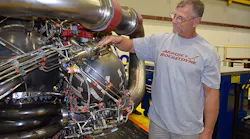
LAMPOLDSHAUSEN, Germany — The German Aerospace Center (DLR) has tested the Prometheus rocket engine on its upgraded P5 test stand in Lampoldshausen, Germany, demonstrating repeated engine ignitions and stable operation during a continuous test sequence.
European aerospace and defense company ArianeGroup is developing Prometheus for the European Space Agency (ESA). The latest campaign builds on earlier testing at the company's Vernon, France, facility.
Related: DLR opens drone security center for UAS and counter-UAS testing
What changed at the P5 test stand?
DLR upgraded P5 to accommodate liquid methane and support repeated engine starts. Prometheus uses liquid methane and liquid oxygen as propellants. The modifications allow engineers to test operating sequences that involve thrust changes, shutdowns and subsequent ignitions.
During testing, the facility supplies the engine with propellants and gases while maintaining the required pressure and temperature conditions.
Instrumentation measures thrust, propellant flow, pressure ratios and temperatures. Engineers use the recordings to look at engine behavior and determine how the test stand responds during different operating phases.
The upgraded facility is part of ESA's rocket propulsion testing infrastructure and is operated by DLR.
Why are repeated ignitions important?
Reusable rocket stages may need to restart their engines after an initial powered flight to carry out return or landing maneuvers.
Each restart requires the engine and its supporting systems to operate under controlled conditions. Between hot-fire tests, personnel must safely shut down the equipment, drain and purge supply lines, and restore the pressure and temperature conditions needed for another ignition. DLR says the facility can carry out these procedures automatically and consistently between tests.
The campaign also examined operation at different thrust levels. Engineers can use these tests to study engine stability, responses to rapid thrust changes and the thermal and mechanical loads associated with those transitions.
How does Prometheus support reusable launch systems?
ArianeGroup is developing the engine under ESA's Future Launchers Preparatory Programme (FLPP), which supports technologies for future European launch vehicles. Prometheus is a 100-tonne-thrust-class engine and uses methane rather than the liquid hydrogen employed in some existing European rocket engines.
Liquid methane has a higher density than liquid hydrogen and can be stored at higher temperatures. These properties can simplify propellant storage and handling requirements.
Germany contributes approximately 80 million euros to ESA's FLPP through its Federal Ministry of Research, Technology and Space, with funding coordinated by the German Space Agency at DLR.