The component fits - but does the system?
Key Highlights
- Smaller components can lead to higher thermal density, creating hotspots and reducing system reliability if not properly managed.
- System-level considerations such as power budgets, thermal behavior, and physical footprint are crucial in component selection, especially under SWaP constraints.
- Environmental factors and qualification standards significantly narrow the pool of suitable parts in defense, aerospace, and space applications.

REDDITCH, U.K. - Making a component smaller can create a bigger thermal problem. Choosing the highest-performing device can increase power demand. And a part that looks ideal on a datasheet may prove difficult to qualify, cool, or support over the life of a program.
Size, weight and power (SWaP) therefore need to be treated as core design considerations in defense, aerospace and space electronics.
In high-reliability applications, a component decision can have consequences far beyond the PCB. Thermal performance, ruggedization, qualification, availability and long-term support can all affect whether an apparently optimal component remains the right choice once it is integrated into the system.
The fundamental question is therefore not simply whether a component meets its individual specification.
The best component is not always the best system choice
Under tight SWaP constraints, it is tempting to select the smallest, lightest or highest-performing component available, but optimization at component level does not necessarily result in optimization at system level.
A device may offer excellent electrical performance but consume more power. A smaller package may save board space but increase power density and make heat harder to remove. A component that looks attractive in isolation may also require additional cooling or supporting circuitry that increases the overall size and weight of the subsystem.
Therefore, the choice must be made in the context of the complete system. Power budgets, thermal behavior, and physical footprint all need to be considered alongside electrical performance. That can lead engineers towards a component that is less impressive on paper but a better fit for the wider architecture.
A power-conversion example illustrates the point. A particular load may appear to require only a small DC-DC converter, but when the power needs of adjacent boards and other parts of the system are considered, a larger converter with multiple outputs may allow two or three smaller devices to be removed.
The individual component is bigger and more expensive, while the system-level result can be simpler and more efficient.
This is where SWaP becomes a specification issue rather than a component-selection exercise.
Smaller can create a bigger thermal problem
The drive towards smaller electronics can create reliability problems if thermal performance is not considered at the same time. Higher power density means more heat is generated within a smaller area. That can lead to hotspots on the PCB, shorten component life and reduce overall system reliability.
The obvious response is to add thermal management. However, heatsinks, fans, heat pipes and other cooling measures consume space, add weight and introduce additional complexity.
The result can be a familiar engineering paradox: reducing the size of individual components can make the overall system harder to cool.
Thermal management shouldn’t be treated as a mechanical problem to be solved after the electronics have been designed. In many applications, it is an architectural constraint that needs to influence component selection and system design from the beginning.
The operating environment makes this even more important.
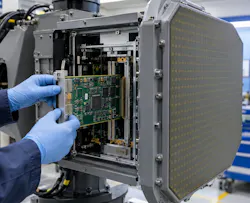
Electronics in a rack can benefit from relatively good airflow. Place the same board in a compact enclosure on an aircraft or military vehicle and natural airflow may be very limited. If the surrounding structure is already hot, as it may be in a vehicle operating in desert conditions, removing internally generated heat becomes harder again.
Thermal performance therefore needs to be part of the specification, rather than something to solve once the rest of the design has been fixed.
Mission and environment narrow the choices
In high-reliability applications, the environment immediately affects which components are realistic options.
Defense and aerospace electronics can be exposed to extreme temperature ranges, vibration, mechanical shock, humidity, salt fog, altitude, and electromagnetic interference. Space adds launch vibration and radiation exposure.
These conditions can reduce the number of suitable parts significantly.
Qualification requirements also matter. Depending on the application, engineers may need to consider standards such as MIL-STD-810, MIL-STD-461, or DO-160, as well as the relevant space qualification requirements.
The specification should remain proportionate to the mission.
The most highly qualified part available may exceed the level of assurance required for a particular application. A lower-cost commercial part may also be unsuitable where the consequences of failure are significant. Component criticality should guide the level of assurance required.
A mission-critical function such as engine management will demand a different level of assurance from a less critical subsystem. The same principle applies in space. A long-duration mission where failure is unacceptable may justify radiation-hardened parts, while a lower-cost satellite in a large constellation may be designed around a different risk model. The specification therefore needs to reflect the operating environment, criticality, expected life and failure consequences of the application.
Commercial and specialist parts are not a simple either-or
There can also be a useful middle ground between standard commercial parts and fully qualified specialist components.
One example involved equipment for a commercial helicopter. The customer didn’t require a fully military-qualified device but selected a part from the same product family and manufacturing lineage as a qualified version. The part itself had not gone through the same full qualification route, but the customer's complete product was subsequently subjected to the required thermal and shock testing.
This example shows why engineers need to understand what level of assurance the program requires and how that fits into the overall qualification strategy. Making that assessment while the design is still flexible gives engineering teams more options. Discovering later that a selected component cannot meet the required environmental or qualification criteria can mean redesign, additional testing, and program delay.
A component must survive the program, not just the test
Performance and reliability are only part of the decision.
Mission-critical platforms can remain in service for decades, while component manufacturers often work to much shorter product cycles. Availability and lifecycle support need to form part of the technology decision.
A component may be technically ideal today but still introduce risk if it is approaching obsolescence, has very limited sourcing options, or does not align with the program's expected production and support life. These issues form part of the wider SWaP decision. A design choice is only robust if the component can realistically be sourced, supported and sustained for as long as the program requires.
Considering that during specification is far less disruptive than redesigning qualified electronics once equipment is already in service.
The value of challenging the specification
Early engagement with semiconductor manufacturers, specialist component suppliers and distributors can help identify issues that may not be apparent from the datasheet alone. That may include thermal characteristics, qualification history, manufacturing lineage, product roadmaps, availability, alternative devices and expected lifecycle support.
It can also expose opportunities to rethink the design.
The right answer may be a different component. It may involve changing peripheral devices. In some cases, it may even mean reconsidering part of the architecture.
The objective should not be to force an application around a particular component. It should be to identify the solution that best fits the application and its long-term requirements.
This wider perspective can also provide access to manufacturer application expertise, qualification experience, and roadmap information that may otherwise be difficult for an engineering team to obtain.
Bringing that thinking into the design cycle early gives engineering teams more opportunity to identify problems while they are still relatively easy to solve.
A thermal, qualification, or availability issue identified while requirements are still being defined can be addressed through the specification. The same issue emerging halfway through development can trigger redesign.
The fundamental question is whether the component helps the entire system meet its objectives. In high-reliability electronics, the best component is rarely the one that wins on a single number. It is the one that delivers the right balance of performance, thermal behavior, assurance, availability, and lifecycle support, without creating a new problem elsewhere in the system.
